

CMS Development Cost 2026: What You'll Actually Pay

Key Points: CMS development costs in 2026 range from $0 for open-source platforms to $300,000+ for enterprise custom solutions. Budget-friendly options like WordPress or Wix start at $10-200/month, mid-range custom CMS projects cost $10,000-120,000, while enterprise implementations require $120,000-300,000+ including hosting, design, integrations, and ongoing maintenance. Your final cost depends on complexity, customization needs, and whether you choose DIY, template-based, or fully custom development.
Planning a content management system project means facing one unavoidable question: what's this going to cost?
The answer isn't straightforward. CMS development costs vary wildly—from literally nothing for basic open-source installations to hundreds of thousands for enterprise-grade custom builds. According to website development cost analyses, most custom websites cost $2,500–$10,000+, with annual maintenance adding another $200 to $10,000+.
But here's the thing: those ranges are basically useless without context.
The real cost depends on dozens of factors: platform choice, customization depth, design complexity, integrations, hosting infrastructure, and ongoing support needs. A small business blog built on WordPress lives in a completely different financial universe than a multi-site enterprise CMS powering international operations.
This breakdown covers every cost factor that matters in 2026. Real numbers, actual pricing structures, and the hidden expenses that catch teams off guard.
Understanding CMS Development Cost Fundamentals
CMS development costs break down into distinct categories that apply whether building with open-source platforms, SaaS solutions, or custom development.
The three core expense areas are: initial development, infrastructure and hosting, and ongoing maintenance. Each carries different weight depending on the approach chosen.
Initial development includes design work, configuration, customization, content migration, and integration with existing systems. Infrastructure covers domain registration, SSL certificates, hosting services, CDN, and backup systems. Maintenance encompasses security updates, content updates, technical support, and periodic feature additions.
Most organizations underestimate the total cost of ownership. The University at Buffalo offers UBCMS, built on the Adobe Experience Manager platform, which does not require coding skills but represents a significant platform investment that extends beyond initial setup.
According to the Bureau of Labor Statistics, computer systems analysts earned a median annual wage of $103,790 in May 2024. This provides context for professional development costs when hiring in-house or contracting expert assistance.
The Three Main CMS Development Approaches
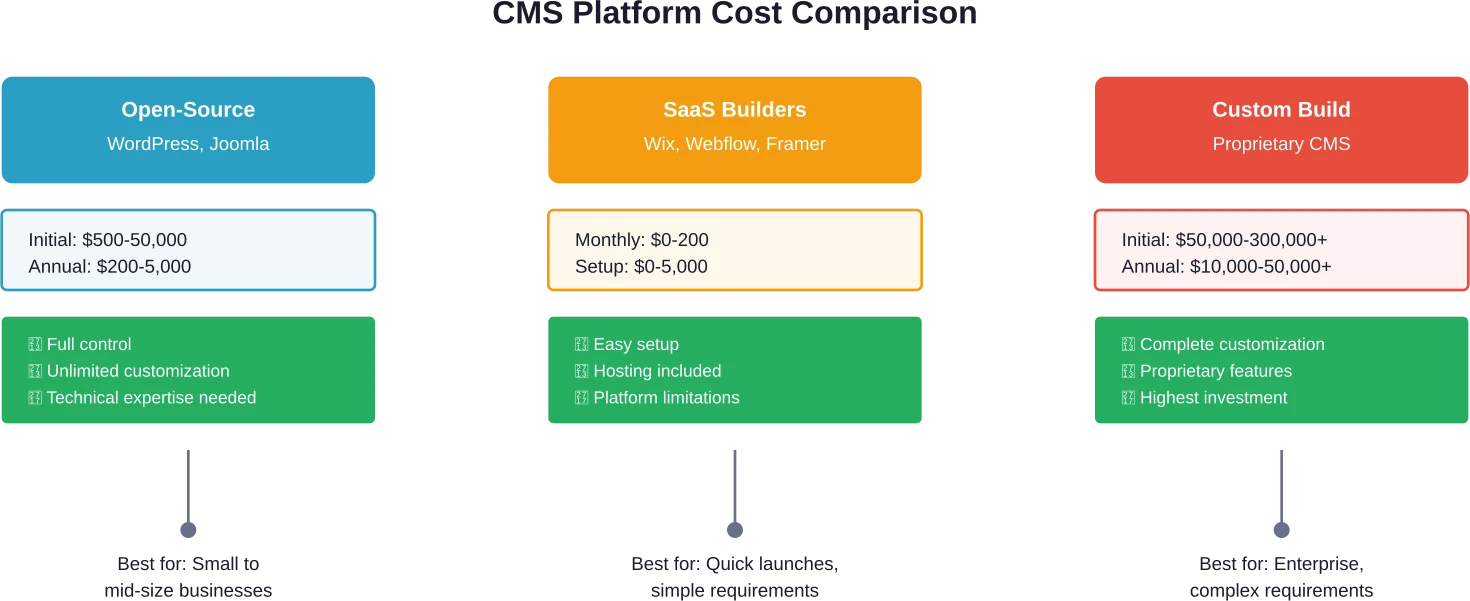
Platform choice fundamentally determines cost structure. The three approaches—open-source, SaaS/website builders, and custom development—operate on completely different financial models.
- Open-source platforms like WordPress, Joomla, and Concrete CMS offer free software but require investment in hosting, themes, plugins, and technical expertise. Concrete CMS positions itself as pairing "robust functionality with ease of use and a low cost of deployment," according to Info-Tech Research Group.
- SaaS website builders like Wix, Webflow, and Framer bundle hosting, templates, and CMS features into monthly subscriptions ranging from $0 to $200+ per month. These eliminate many technical requirements but impose platform limitations.
- Custom development involves building proprietary CMS functionality tailored to specific business requirements. This approach starts around $50,000 and scales into six figures for enterprise implementations.
The right approach depends entirely on requirements, technical capabilities, and long-term strategic goals.

Calculate CMS Development Cost
CMS development cost depends on content structure, user roles, custom features, and integrations. OSKI Solutions defines system architecture before calculating development effort. The estimate includes backend setup, frontend templates, and testing. You receive a practical CMS budget based on actual functionality.
Ready to Estimate Your CMS Budget?
Talk with OSKI Solutions to:
- define content structure and permissions
- estimate development and integration effort
- receive a structured CMS cost breakdown
👉 Request a CMS development quote from OSKI Solutions.
Build a Powerful CMS Platform
We develop custom content management systems that simplify publishing, improve collaboration, and scale with your business.
Open-Source CMS Development Costs
The "free" label on open-source platforms misleads. While the software itself costs nothing, the total implementation carries substantial expenses.
WordPress dominates the open-source CMS market. But "free WordPress" actually means free software with paid everything else.
WordPress Cost Breakdown
Quality hosting for WordPress ranges from $10 to several hundred dollars monthly. Shared hosting handles small sites, but traffic growth and performance needs push costs toward VPS or dedicated hosting quickly.
SSL certificates add another expense, though many hosting providers now include basic SSL. Domain registration runs $10-30 annually depending on TLD and registrar.
Premium themes cost $30-200 for one-time purchases, though sophisticated themes and frameworks reach $500+. Premium plugins add $15-300 each, with essential functionality often requiring multiple paid extensions.
Development and customization form the largest variable cost. Basic setup might take 10-20 hours at $50-150 per hour for freelance developers. Complex custom themes or plugin development can consume 100+ hours, pushing costs toward $15,000-30,000 for sophisticated implementations.
|
Cost Component |
Range |
Frequency |
|---|---|---|
|
Hosting |
$10-500/month |
Monthly |
|
Domain |
$10-30 |
Annual |
|
SSL Certificate |
$0-200 |
Annual |
|
Premium Theme |
$30-500 |
One-time |
|
Premium Plugins |
$50-1,000+ |
Annual/One-time |
|
Development |
$500-30,000 |
One-time |
|
Maintenance |
$200-2,000 |
Annual |
Maintenance for WordPress sites typically costs $200-2,000 annually for security updates, plugin updates, backups, and minor content changes. Sites requiring active development or complex technical management push annual costs higher.
Other Open-Source Platforms
Joomla and Drupal follow similar cost structures with variations in development complexity. Drupal generally requires more technical expertise, increasing development costs but offering greater flexibility for complex architectures.
Concrete CMS emphasizes ease of use while maintaining the open-source model. According to Info-Tech Research Group, Concrete CMS pairs robust functionality with ease of use and a low cost of deployment
Total realistic costs for open-source CMS implementations range from $500-10,000 for basic sites to $10,000-50,000+ for sophisticated custom builds, plus ongoing annual costs of $200-5,000 for maintenance and hosting.
SaaS Website Builder and CMS Costs
Website builders bundle CMS functionality, hosting, and templates into subscription models that simplify budgeting but introduce different cost considerations.
Website builders cost between $0 and $200+ monthly depending on features, storage, bandwidth, and capabilities included.
Wix Pricing Structure
Wix operates on tiered pricing from free plans with limitations to business and ecommerce plans reaching $200+ monthly. The platform includes drag-and-drop builders, hosting, domains, and CMS features across all paid tiers.
Free plans display Wix branding and use Wix subdomains. Paid plans unlock custom domains, remove ads, and increase storage and bandwidth allocations.
Design work can be handled through templates (included) or professional designers ($500-5,000 depending on complexity). The platform reduces technical overhead but constrains customization compared to open-source alternatives.
Webflow Cost Analysis
Webflow positions between simple builders and custom development. Pricing separates site plans ($14-39/month) from workspace plans for teams.
The platform offers significant design freedom and CMS capabilities while generating clean code. However, complex customizations may still require developer expertise at $75-150+ hourly rates.
According to platform comparisons, Webflow combined with design services represents a middle-ground option for teams wanting custom aesthetics without full custom development costs.
Framer and Other Modern Builders
Framer and similar modern builders target design-forward teams with pricing structures comparable to Webflow. Monthly costs range from free tiers to $20-50 for professional features.
These platforms reduce development time but introduce learning curves and platform-specific limitations. Lock-in becomes a consideration—migrating away from proprietary builders often requires rebuilding from scratch.
Hidden Costs in SaaS Platforms
Subscription models appear straightforward but hide several cost factors. Transaction fees on ecommerce plans can eat 2-3% of revenue. Third-party integrations often require separate subscriptions—email marketing tools, analytics platforms, and specialized functionality stack monthly fees quickly.
According to platform comparison analysis, website builders can accumulate hidden costs including complex setup costs with hosting quality services ranging from $10 to several hundred dollars per month, SSL certificates, and premium features that aren't obvious in base pricing.
Template customization frequently requires hiring designers familiar with specific platforms. While less expensive than custom development, expect $500-3,000 for professional template customization.
Total SaaS CMS costs typically range from $200-2,400 annually for basic implementations to $5,000-15,000+ annually for business-grade deployments with professional design and multiple integrations.
Custom CMS Development Costs
Custom CMS development represents the highest investment tier but delivers solutions precisely matched to business requirements.
According to app development cost analyses, simple app development costs $5,000–$50,000, medium complexity runs $50,000–$120,000, and complex development reaches $120,000–$300,000+.
What Drives Custom Development Costs
Complexity determines everything. A basic custom CMS with standard features (content editing, user management, basic workflow) sits at the lower end. Enterprise systems with advanced permissions, multi-site management, complex workflows, API integrations, and custom modules push costs significantly higher.
Development team composition affects pricing. Freelancers charge $50-150 hourly, agencies run $100-250+ hourly, and specialized enterprise firms command $200-400+ hourly rates.
According to Bureau of Labor Statistics data, the median annual wage for computer systems analysts was $103,790 in May 2024, providing context for in-house development team costs.
Project timeline correlates with cost. A three-month build costs substantially less than a twelve-month implementation, though compressed timelines may require larger teams and increase hourly rates.
Custom CMS Cost Breakdown
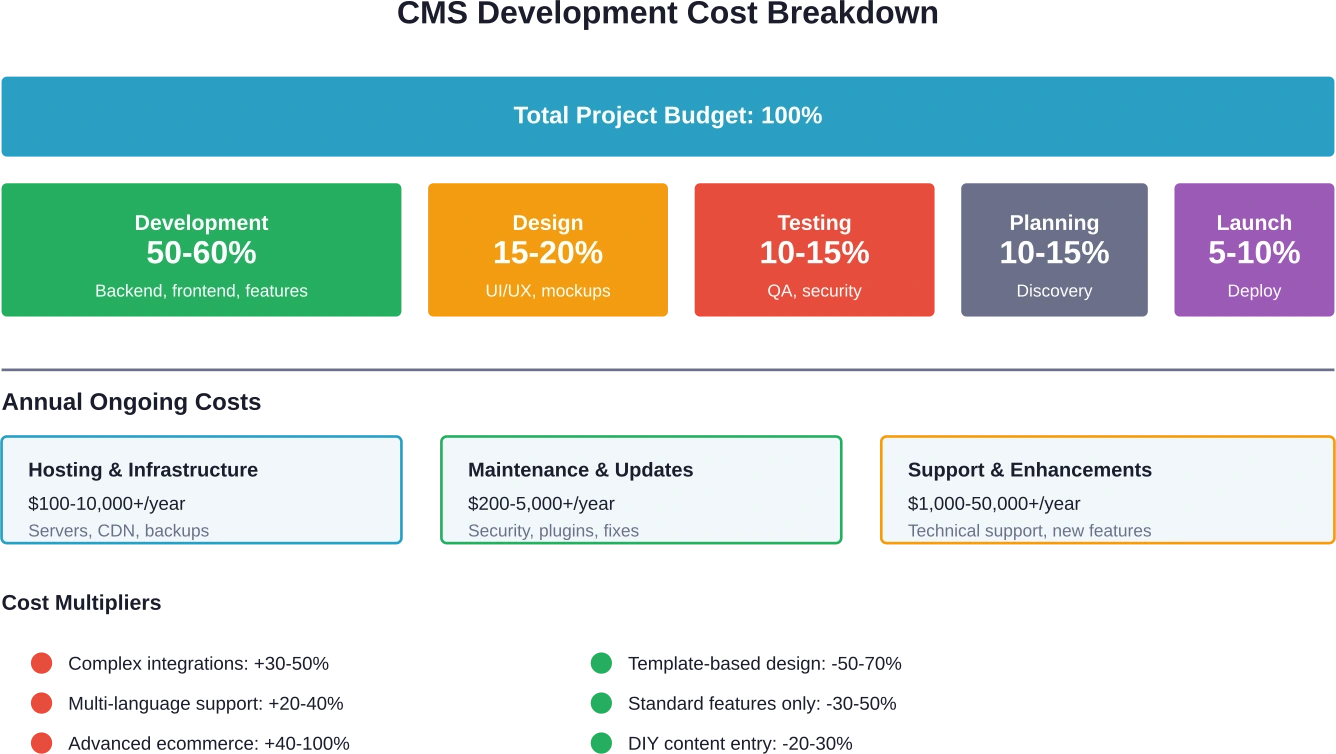
Discovery and planning typically consume 10-15% of budget. This phase defines requirements, creates technical specifications, designs architecture, and establishes project scope.
Design work takes another 15-20%—wireframes, mockups, user interface design, and user experience optimization. Complex designs with custom interactions increase this percentage.
Core development represents 50-60% of total cost. This includes backend architecture, database design, CMS functionality, API development, and frontend implementation.
Testing and quality assurance require 10-15%. Comprehensive testing catches bugs, validates functionality, ensures security, and confirms performance standards.
Deployment and launch activities take up the remaining 5-10%—server configuration, migration, training, and go-live support.
|
Complexity Level |
Cost Range |
Timeline |
Typical Features |
|---|---|---|---|
|
Simple |
$5,000-50,000 |
1-3 months |
Basic content management, simple workflow, standard templates |
|
Medium |
$50,000-120,000 |
3-6 months |
Custom modules, integrations, advanced permissions, multi-language |
|
Complex |
$120,000-300,000+ |
6-12+ months |
Enterprise features, multi-site, custom workflows, extensive integrations |
Enterprise CMS Implementations
Enterprise deployments involve additional cost factors beyond development. Change management, staff training, process redesign, and organizational alignment add substantial soft costs.
According to Harvard Business School analysis of digital transformation and AI implementation, organizations often underestimate what successful implementation requires. This applies equally to major CMS deployments—they demand "significant investment in technology, data, integration, and talent."
Infrastructure for enterprise CMS runs higher than standard hosting. Redundant servers, load balancing, CDN, advanced security, and backup systems add $1,000-10,000+ monthly in hosting and infrastructure costs.
Integration with existing enterprise systems—ERP, CRM, marketing automation, analytics platforms—adds complexity and cost. Each integration might require $5,000-50,000 depending on system complexity and data synchronization requirements.
Key Cost Factors Affecting CMS Development
Specific factors drive costs regardless of platform choice. Understanding these helps estimate realistic budgets and identify potential overruns before they happen.
Design Complexity
Template-based designs cost least—$0-1,000 for premium templates with minor customization. Custom designs start around $3,000-10,000 for professional work. Highly custom, interactive designs with animation, advanced UX, and sophisticated visual elements reach $15,000-50,000+.
The number of unique page templates multiplies design costs. A site needing 15 different layouts costs substantially more than one needing three templates.
Functionality Requirements
Standard CMS features come bundled in most platforms. Custom functionality drives costs up quickly.
Ecommerce capabilities add $1,000-50,000 depending on complexity. Basic product catalogs sit at the low end; sophisticated inventory management, multiple payment gateways, complex shipping logic, and custom checkout flows push toward the high end.
User portals with authentication, personalization, and custom dashboards add $5,000-30,000. Multi-language support increases costs by 20-40% depending on the number of languages and content volume.
Advanced search functionality, custom reporting, API development, and third-party integrations each represent individual cost centers ranging from $2,000-20,000 per major feature.
Content Migration
Moving existing content into a new CMS rarely gets budgeted adequately. Simple migrations from one CMS to another with similar structures might cost $1,000-5,000.
Complex migrations involving content restructuring, taxonomy redesign, URL mapping, metadata preservation, and extensive quality assurance run $10,000-50,000+ depending on content volume and complexity.
Manual content entry for hundreds or thousands of pages adds significant labor costs at $50-150 per hour for content specialists.
Integrations and APIs
Each system integration introduces development, testing, and maintenance costs. Standard integrations with popular platforms (Google Analytics, Mailchimp, Salesforce) might use pre-built connectors costing $0-500.
Custom API integrations require development work at $5,000-30,000 per integration depending on complexity, data volume, real-time requirements, and error handling needs.
According to MIT Sloan Management Review, rapid AI deployment creates dangerous technical debt that can cripple scalability, destabilize systems, and leave companies worse off when deployed carelessly This applies to hasty integrations—cutting corners on integration architecture creates expensive problems later.
Security Requirements
Basic security comes standard in most platforms. Enhanced security for sensitive data, compliance requirements (GDPR, HIPAA, PCI-DSS), and enterprise-grade protection add costs.
Security audits cost $5,000-25,000. Penetration testing runs $10,000-50,000. Ongoing security monitoring and incident response services add $200-2,000+ monthly.
SSL certificates for basic sites cost $0-200 annually. Extended validation certificates and wildcard certificates for multiple subdomains run $200-1,000 annually.
Hosting and Infrastructure Costs
Hosting represents a recurring expense that varies dramatically based on traffic, performance requirements, and uptime expectations.
Shared Hosting
Entry-level shared hosting costs $3-10 monthly. Multiple sites share server resources, making this suitable only for small sites with minimal traffic.
Performance suffers during traffic spikes. Security risks increase when sharing servers with other sites. Most serious CMS implementations quickly outgrow shared hosting limitations.
VPS and Cloud Hosting
Virtual private servers provide dedicated resources at $20-100 monthly for standard configurations. This handles moderate traffic and provides better performance and security than shared hosting.
Cloud hosting from providers like AWS, Google Cloud, or Azure offers scalability but introduces complexity. Costs range from $50-500+ monthly depending on traffic, storage, and services utilized.
Cloud pricing models charge for actual usage—compute time, storage, bandwidth, and various services. This creates variable monthly costs that scale with traffic but require monitoring to avoid surprise bills.
Managed and Dedicated Hosting
Managed hosting includes server administration, security monitoring, backups, and technical support. Prices run $100-500+ monthly depending on performance tiers and included services.
Dedicated servers provide complete control and maximum performance at $200-2,000+ monthly. Enterprise hosting with redundancy, load balancing, and advanced features reaches $2,000-10,000+ monthly.
Additional Infrastructure Costs
CDN services improve global performance by caching content closer to users. Basic CDN costs $5-50 monthly; enterprise CDN reaches $200-2,000+ depending on traffic and geographic coverage.
Automated backup services add $10-100 monthly. Monitoring and uptime services cost $10-50 monthly. Email hosting, if not included, adds another $5-50 monthly per mailbox.
Ongoing Maintenance and Support Costs
The launch date isn't the finish line. Ongoing costs maintain security, performance, and functionality.
Maintenance Plans
According to website development cost analyses, maintenance typically includes security updates, plugin and theme updates, uptime monitoring, backups, and small content fixes with typical response times of 24-48 hours on business days.
Basic maintenance plans cost $200-1,000 annually and cover essential security updates and minor fixes. Standard plans at $1,000-3,000 annually add regular updates, performance monitoring, and priority support. Premium maintenance reaches $3,000-10,000+ annually with dedicated support, proactive monitoring, and included development hours.
Content Updates
Organizations handle content updates three ways: in-house staff, retainer agreements with agencies, or hourly arrangements.
In-house content managers represent full-time salary costs. Content specialists earn $40,000-70,000 annually depending on market and experience.
Retainer agreements provide predictable monthly costs for regular updates. Expect $500-2,000 monthly for 5-20 hours of content work, depending on complexity and volume.
Hourly arrangements work for occasional updates at $50-150 per hour for content specialists.
Technical Support
Technical issues require developer expertise. Support costs depend on arrangement type and issue complexity.
Included support hours (common in maintenance plans) provide 2-10 hours monthly at no additional cost beyond the plan fee. Additional hours bill at $100-250 per hour depending on provider and urgency.
Emergency support outside business hours typically carries 1.5-2x multipliers on standard hourly rates.
Feature Enhancements
CMS needs evolve. New features, functionality improvements, and capability expansions represent ongoing development costs.
Small enhancements might require 5-20 hours at standard developer rates. Major new features consume 40-200+ hours. Enterprise feature development can represent multi-month projects costing $50,000-200,000+.
Budgeting 10-20% of initial development costs annually for enhancements provides realistic planning for growing organizations.
Industry-Specific CMS Costs
Certain industries face unique CMS requirements that affect costs.
Ecommerce Sites
Ecommerce adds substantial complexity and cost. Product management, inventory systems, payment processing, shipping calculation, and order management require specialized functionality.
Basic ecommerce on platforms like Shopify or WooCommerce starts at $30-300 monthly plus transaction fees. Custom ecommerce development runs $30,000-200,000+ depending on catalog size, customization needs, and integration requirements.
Transaction fees from payment processors (2-3% typically) and platform-specific fees (Shopify charges 0.5-2% on top of payment processing) create ongoing costs that scale with revenue.
Publishing and Media Sites
Media sites require robust content workflows, editorial tools, multiple author management, and high-traffic infrastructure.
Specialized publishing CMS platforms cost $200-2,000+ monthly. Custom publishing systems start around $50,000 and scale to $200,000+ for enterprise implementations.
High traffic demands premium hosting. Media sites commonly spend $500-5,000+ monthly on infrastructure alone.
Healthcare and Regulated Industries
HIPAA compliance, enhanced security, audit logging, and specialized access controls add significant costs to healthcare CMS implementations.
Compliance requirements increase development costs by 30-50%. Ongoing compliance monitoring and audits add $10,000-50,000+ annually.
Specialized hosting meeting regulatory requirements costs $500-3,000+ monthly compared to standard hosting.
Enterprise and Multi-Site Deployments
Organizations managing multiple sites or international operations face additional complexity. Multi-site management, centralized administration, and content syndication require enterprise-grade CMS capabilities.
Enterprise CMS platforms like Adobe Experience Manager or Sitecore cost $50,000-500,000+ in licensing annually. Implementation services add another $200,000-2,000,000+ depending on scale and customization.
The University at Buffalo's implementation of UBCMS on Adobe Experience Manager exemplifies institutional-scale CMS investment, though specific costs weren't disclosed.
Hidden Costs That Catch Teams Off Guard
Several expense categories commonly get overlooked during initial budgeting.
Training and Onboarding
Staff need training on new CMS platforms. Simple systems require 2-4 hours of training; complex enterprise systems need 8-40 hours per user role.
Training costs include trainer time ($100-250 per hour), documentation creation, and employee productivity loss during learning curves. Budget $1,000-10,000+ for comprehensive training programs.
Content Creation
Building the CMS is one thing. Filling it with quality content is another. Organizations often underestimate content creation costs.
Professional content creation costs $100-500 per page depending on research requirements, length, and technical complexity. Photography runs $500-3,000 per day. Video production ranges from $1,000-10,000+ per finished minute.
SEO and Marketing Tools
CMS platforms provide basic functionality, but serious digital marketing requires specialized tools.
SEO platforms like Ahrefs or SEMrush cost $100-500 monthly. Marketing automation tools range from $50-2,000+ monthly. Analytics and conversion optimization tools add another $50-500 monthly.
Legal and Compliance
Privacy policies, terms of service, cookie consent management, and data protection measures require legal review and technical implementation.
Legal document preparation costs $1,000-5,000. Cookie consent and privacy management tools add $10-200 monthly. Comprehensive compliance programs for regulated industries require $10,000-100,000+ initially plus ongoing costs.
Performance Optimization
Sites that launch with adequate performance often degrade as content and traffic grow. Performance optimization becomes a recurring need.
Performance audits cost $2,000-10,000. Optimization work runs $5,000-30,000 for comprehensive improvements including image optimization, caching configuration, code optimization, and CDN implementation.
How to Budget for CMS Development
Realistic budgeting prevents costly surprises and project failures.
Establishing Requirements
Start with comprehensive requirements gathering. Document all functionality needs, integration requirements, user roles, content types, and workflow processes.
Clear requirements prevent scope creep—the primary cause of budget overruns. Undefined or evolving requirements add 30-100% to initial estimates.
Getting Accurate Estimates
Obtain detailed estimates from multiple vendors. Beware of estimates that seem too good—they usually indicate missing requirements or unrealistic assumptions.
Detailed estimates break down costs by phase, feature, and resource. Vague lump-sum estimates hide uncertainty and risk.
Building Contingency
Add 15-30% contingency to any development budget. Software projects routinely encounter unforeseen challenges, requirement clarifications, and technical complications.
Projects without contingency either cut features to stay on budget or exceed budget and cause organizational problems.
Phased Development
Consider phased approaches that launch with core functionality and add features incrementally. This spreads costs over time and provides earlier value realization.
Minimum viable product (MVP) approaches launch faster at lower initial cost, with subsequent phases adding sophistication based on real user feedback.
|
Budget Range |
Realistic Approach |
What to Expect |
|---|---|---|
|
Under $5,000 |
DIY website builder or basic WordPress template |
Template design, limited customization, self-managed |
|
$5,000-15,000 |
Professional template customization or simple custom site |
Custom design, basic functionality, professional setup |
|
$15,000-50,000 |
Custom WordPress/CMS with moderate customization |
Custom design and development, integrations, training |
|
$50,000-120,000 |
Sophisticated custom CMS or complex WordPress build |
Advanced functionality, multiple integrations, custom modules |
|
$120,000+ |
Enterprise custom development or platform implementation |
Complete custom solution or enterprise platform with extensive configuration |
ROI Considerations for CMS Investment
CMS costs must be evaluated against business value delivered.
Efficiency Gains
Effective CMS platforms reduce content management time by 40-60% compared to manual processes or outdated systems. This represents real labor savings.
Calculate current content management hours and hourly costs. Apply realistic efficiency improvements. A team spending 80 hours monthly on content management at $50/hour loaded cost ($4,000/month) that achieves 50% efficiency gains saves $2,000 monthly—$24,000 annually.
Revenue Impact
For ecommerce and lead-generation sites, CMS improvements directly affect revenue. Better performance, improved user experience, and enhanced functionality increase conversion rates.
A 10% conversion improvement on a site generating $500,000 annually produces $50,000 additional revenue. This justifies substantial CMS investment when improvements deliver measurable results.
Cost of Not Investing
Outdated or inadequate CMS platforms create hidden costs: lost opportunities, inefficient workflows, security vulnerabilities, poor user experience, and competitive disadvantage.
Organizations often delay CMS investments until problems become critical, increasing eventual costs and organizational disruption.
Long-Term Value
According to Harvard Business School's analysis of technology implementation, becoming an AI-enabled or digitally transformed organization "is a long-term commitment" requiring sustained investment in technology, integration, and talent.
This applies to CMS strategy. One-time projects fail. Successful organizations treat CMS as ongoing capability requiring continuous investment, optimization, and evolution.
Comparing CMS Options: Decision Framework
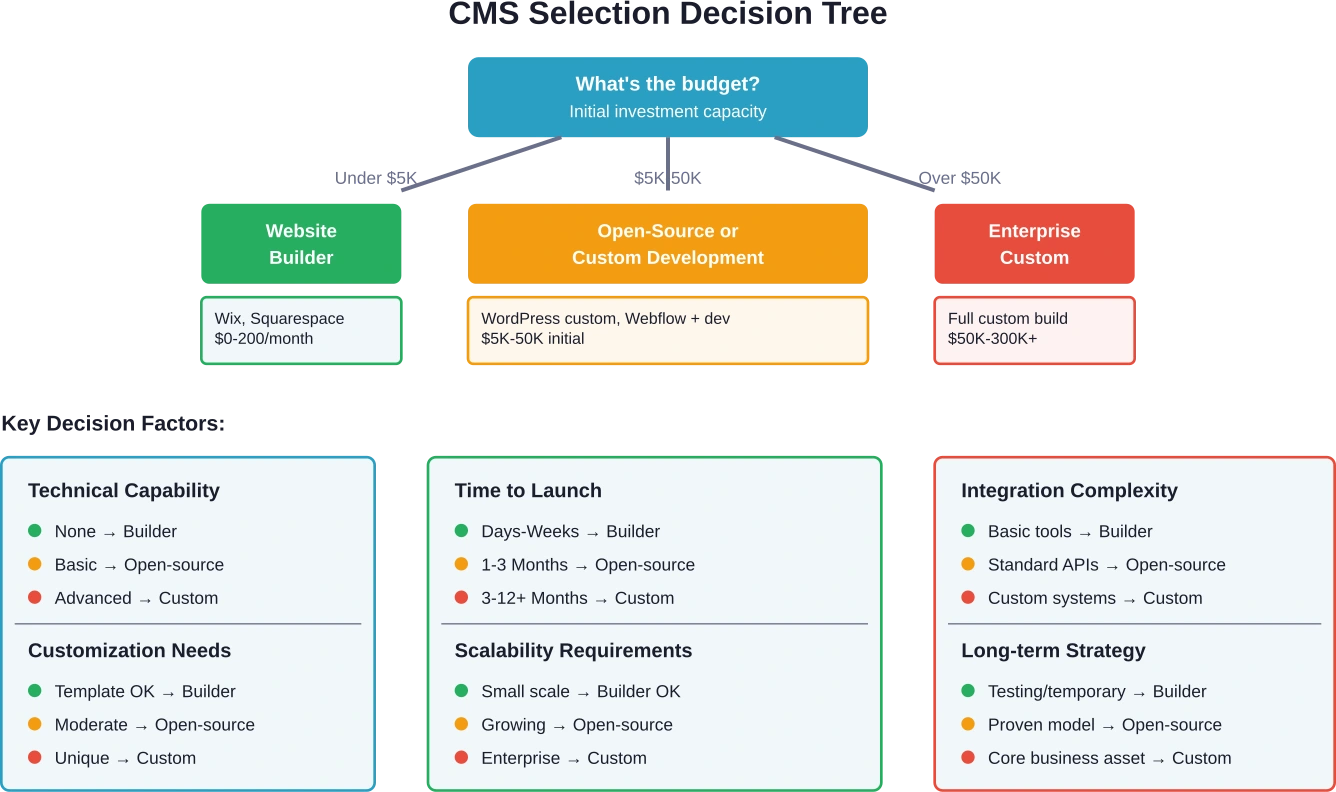
Choosing between CMS approaches requires evaluating multiple factors beyond initial cost.
Control and Flexibility
Open-source and custom development provide maximum control. Organizations can modify anything, integrate with any system, and avoid vendor lock-in.
SaaS platforms trade control for convenience. Template and platform limitations restrict customization but eliminate technical management overhead.
Technical Resources
Available technical expertise influences viable options. Organizations without development resources struggle with open-source platforms requiring configuration and maintenance.
Teams with strong technical capabilities maximize value from flexible platforms while avoiding the constraints and ongoing costs of proprietary builders.
Time to Market
Website builders launch sites in days or weeks. Custom development requires months. Time sensitivity affects approach selection.
Organizations needing immediate presence often launch with builders, planning migration to more robust solutions as requirements clarify and resources allow.
Growth Trajectory
Expected growth influences platform selection. Small sites expecting moderate traffic suit simple solutions. High-growth scenarios require scalable architectures from the start.
Migrating platforms later adds cost and complexity. Building on foundations that accommodate expected growth prevents costly rebuilds.
Frequently Asked Questions
How much does a basic CMS website cost in 2026?
A basic CMS website costs $0-5,000 using website builders like Wix with free or low-cost plans, $500-10,000 for WordPress with basic customization, or $5,000-15,000 for professional custom development with simple features. Ongoing costs add $200-2,000 annually for hosting, maintenance, and updates. The final cost depends on whether work is handled DIY, with templates, or through professional services.
What's the cheapest way to build a CMS website?
The cheapest approach uses free website builders like Wix's free plan or WordPress.org with free hosting trials, free themes, and DIY setup. This costs $0 initially but includes limitations like platform branding, restricted features, and low storage. Adding a custom domain ($10-30 annually) and basic hosting ($3-10 monthly) while handling all setup and content yourself keeps costs under $200 annually.
How much does WordPress website development cost?
WordPress development costs range from $500-50,000+ depending on complexity. Basic setup with a premium theme costs $500-3,000, moderate customization runs $3,000-15,000, and fully custom WordPress development reaches $15,000-50,000+. Ongoing costs include hosting ($10-200 monthly), premium plugins ($50-500 annually), and maintenance ($200-2,000 annually). Professional developer rates run $50-150 hourly, influencing total costs based on required customization hours.
What are hidden costs in CMS development?
Hidden costs include SSL certificates ($0-200 annually), premium plugins ($50-1,000+), third-party integrations ($0-500 each), content creation ($100-500 per page), professional photography ($500-3,000), SEO tools ($100-500 monthly), training ($1,000-10,000), performance optimization ($5,000-30,000), security audits ($5,000-25,000), compliance consulting ($10,000-100,000), and ongoing maintenance that's higher than initially estimated. Many projects exceed budgets by 30-50% due to overlooked expenses.
How much does enterprise CMS cost?
Enterprise CMS implementations cost $120,000-300,000+ for custom development or $50,000-500,000+ annually for enterprise platforms like Adobe Experience Manager or Sitecore. Implementation services add $200,000-2,000,000+ depending on complexity, customization, and integration requirements. Infrastructure costs run $1,000-10,000+ monthly for enterprise-grade hosting. Annual maintenance reaches $10,000-50,000+ for support, updates, and enhancements. Total five-year cost of ownership typically exceeds $1,000,000 for major enterprise deployments.
Should I use a website builder or custom CMS?
Choose website builders (Wix, Squarespace, Webflow) for budgets under $5,000, quick launches, limited technical resources, and simple requirements. Select custom CMS development for budgets exceeding $15,000, unique functionality needs, complex integrations, scalability requirements, or when the website represents a core business asset. Open-source platforms like WordPress offer middle-ground solutions for $5,000-50,000 budgets with moderate technical capabilities, providing more flexibility than builders and lower costs than fully custom development.
What does CMS maintenance cost annually?
CMS maintenance costs $200-10,000+ annually depending on complexity. Basic maintenance (security updates, backups, minor fixes) costs $200-1,000 annually. Standard plans with monitoring and priority support run $1,000-3,000 annually. Premium maintenance with dedicated support reaches $3,000-10,000 annually. Enterprise sites spend $10,000-50,000+ annually on maintenance, support, security monitoring, and continuous improvements. Budget 15-20% of initial development costs annually for realistic ongoing maintenance and enhancement needs.
Making Your CMS Investment Decision
CMS development costs vary dramatically based on approach, requirements, and long-term strategy.
For organizations with limited budgets and simple needs, website builders provide functional solutions at minimal cost. These work particularly well for testing business models, establishing initial presence, or handling straightforward content presentation.
Open-source platforms like WordPress balance flexibility and cost for mid-market organizations. Initial investment ranges from $500-50,000 depending on customization depth, with reasonable ongoing costs for hosting and maintenance. This approach suits businesses with moderate technical capabilities or budgets for occasional professional assistance.
Custom CMS development makes sense for organizations with unique requirements, complex integrations, or strategic needs that existing platforms don't address. Initial costs start around $50,000 and scale to hundreds of thousands for enterprise implementations, but deliver precisely matched solutions without platform limitations.
The critical factor isn't choosing the cheapest option—it's selecting the approach that delivers required functionality within budget constraints while supporting long-term business objectives.
According to computer systems analyst employment data from the Bureau of Labor Statistics, these professionals who design organizational computer system improvements earned a median wage of $103,790 in May 2024. This reflects the market value of expertise required for sophisticated CMS implementations.
But here's what matters most: total cost of ownership extends far beyond initial development. Factor in hosting, maintenance, enhancements, training, content creation, marketing tools, and inevitable evolution as business needs change.
Organizations that budget realistically, choose platforms matching their capabilities, plan for ongoing costs, and treat CMS as strategic capability rather than one-time project achieve the best outcomes.
The right CMS investment delivers measurable business value through efficiency gains, revenue growth, improved user experience, and competitive advantage. Poor CMS decisions create ongoing frustration, hidden costs, and eventual expensive replacements.
Start with clear requirements. Get detailed estimates from multiple sources. Include contingency budgets. Plan for ongoing costs. Evaluate options based on total cost of ownership, not just initial price tags.
Ready to move forward with your CMS project? Invest time in thorough planning before committing resources. The upfront planning effort prevents costly mistakes and ensures the chosen approach actually solves business problems rather than creating new ones.
And remember—according to research on digital transformation from Harvard Business School, successful technology implementation requires sustained commitment to technology, integration, and talent development. One-time projects fail. Ongoing investment in CMS capabilities delivers lasting business value.


