

Cloud Migration Cost Guide 2026: What You'll Actually Pay

Quick Summary: Cloud migration costs typically range from tens of thousands to millions of dollars depending on workload complexity, data volume, and service model choice. Direct expenses include infrastructure, labor, and software licensing, while indirect costs such as training, downtime, and post-migration optimization often add 20-30% to initial estimates. Organizations can control costs through governance-driven planning, right-sizing resources, and leveraging tools like Reserved Instances or savings plans.
Moving workloads to the cloud sounds straightforward until the invoices start arriving. The sticker shock hits harder when organizations realize their initial estimates missed half the actual expenses.
Here's the reality: cloud migration costs extend far beyond monthly subscription fees. Direct expenses like infrastructure and licensing sit alongside indirect costs—training, downtime, organizational changes—that budgets often overlook. According to Deloitte's Cloud ROI Benchmark cited in industry sources, enterprises that fail to model indirect costs such as reskilling and governance automation spend significantly more than those with integrated financial governance.
But there's a framework that works. Organizations with governance-driven migration models consistently control budgets better than those winging it.
What Drives Cloud Migration Costs in 2026
Cloud migration expenses break down into three categories: direct, indirect, and post-migration. Each carries weight, and missing any category means budget overruns become inevitable rather than avoidable.
Direct costs are the obvious ones. Infrastructure subscription fees, labor for the migration project, and software licensing represent the baseline. These expenses appear on spreadsheets early in planning phases.
Indirect costs? That's where budgets go sideways.
Training staff on new cloud platforms, managing downtime during cutover periods, and restructuring teams around cloud-native workflows all carry price tags. Organizations often underestimate these by 20-30%, creating budget gaps that emerge mid-project.
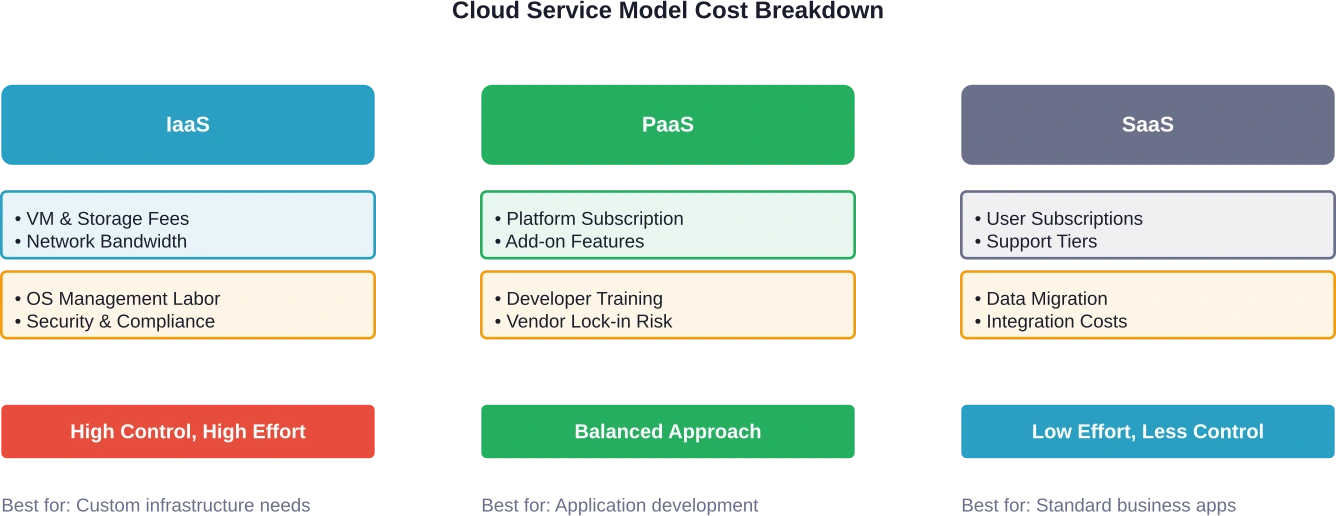
The service model chosen fundamentally alters cost structures. Migrating to Infrastructure as a Service (IaaS) won't cost the same as moving to Platform as a Service (PaaS) or Software as a Service (SaaS).
IaaS Cost Structure
IaaS bills cover cloud computing resources, network bandwidth, and storage. Vendors charge for subscription access to virtual machines, load balancers, and storage volumes. Organizations retain responsibility for managing operating systems, middleware, and applications—which means maintaining internal expertise and paying for that specialized labor.
PaaS Cost Considerations
PaaS bundles all hardware and software resources needed to develop, run, and manage applications. Costs include the platform subscription plus any premium features or add-ons selected. Development teams gain productivity, but vendor lock-in risks increase alongside monthly bills.
SaaS Migration Economics
SaaS shifts almost everything to operational expenses. Monthly or annual subscriptions cover application access, updates, and support. Upfront costs drop dramatically, but long-term expenses accumulate as subscription fees compound year after year.
Calculating Your Cloud Migration Budget
Accurate cost estimation requires breaking the migration into measurable components. Six elements form the foundation of reliable budgets.
Planning and oversight costs cover initial assessment, architecture design, and project management. This phase determines which workloads move to the cloud and in what sequence. Skimping here creates chaos downstream.
Migration labor represents the technical work: configuring cloud resources, transferring data, testing applications, and executing cutover. Experienced engineers cost more per hour but finish faster with fewer errors. That math works out favorably compared to cheaper resources who extend timelines and introduce bugs.
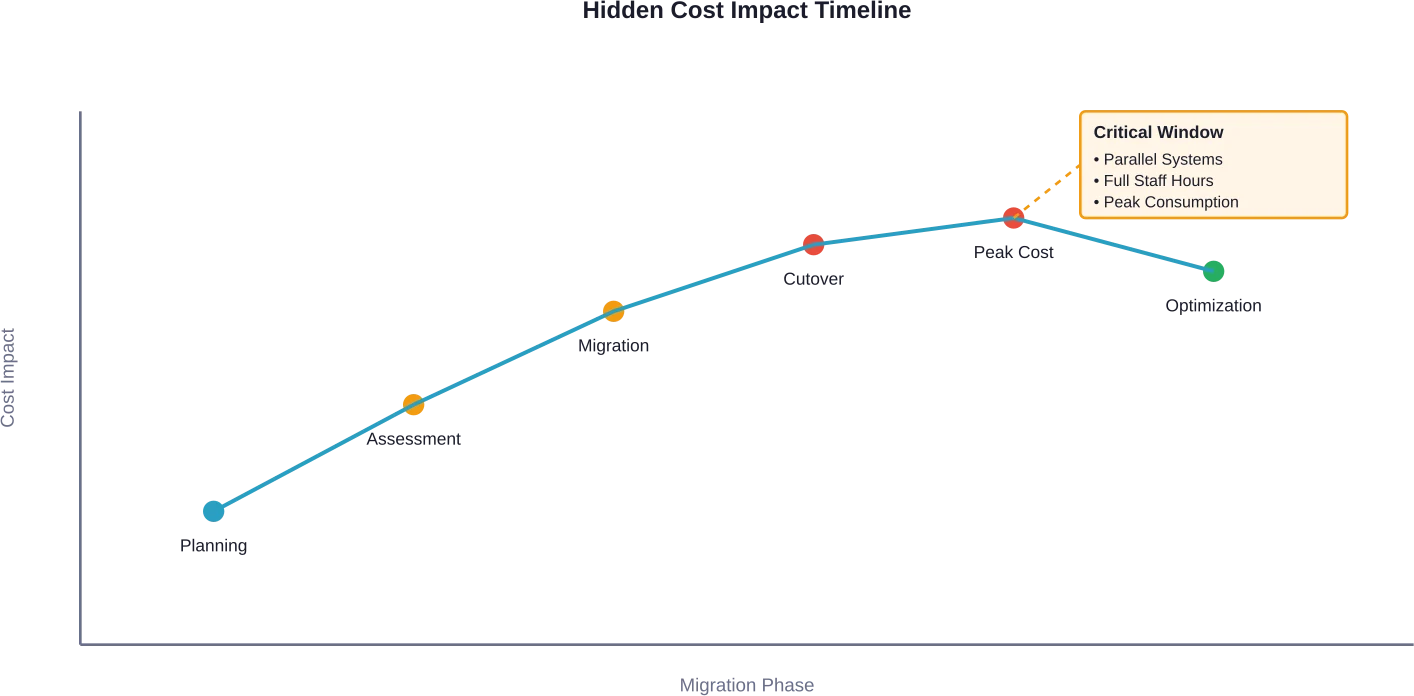
Infrastructure consumption during migration often gets overlooked. Running parallel environments—maintaining on-premises systems while spinning up cloud resources—doubles costs temporarily. That overlap period might last weeks or months depending on migration complexity.
|
Cost Element |
Typical Range |
Key Factors |
|---|---|---|
|
Planning & Oversight |
10-15% of total |
Assessment depth, architectural complexity |
|
Migration Labor |
30-40% of total |
Workload count, customization needs |
|
Infrastructure Overlap |
15-25% of total |
Migration timeline, parallel run duration |
|
Software Licensing |
10-20% of total |
License portability, vendor terms |
|
Training & Change Management |
5-10% of total |
Team size, skill gaps |
|
Post-Migration Optimization |
10-15% of total |
Resource tuning, performance fixes |
Software licensing deserves special attention. Some licenses transfer to cloud environments at no additional cost. Others require repurchasing or converting to subscription models. Vendors handle this differently, and surprises here wreck budgets.
Training and change management prepare teams for new workflows. Cloud platforms introduce different tools, dashboards, and operational models. Staff productivity drops temporarily during the learning curve—a cost that's real even if it doesn't appear as a line item.
Redevelopment costs emerge when applications need modification to run effectively in the cloud. Legacy systems built for on-premises environments sometimes require significant refactoring. This work might involve rewriting components, adopting cloud-native services, or redesigning architectures for scalability.
Request Fees and Data Transfer
Cloud vendors charge for API requests and data movement in ways that catch organizations off guard. Request fees apply per 1,000 operations—PUT, COPY, POST, LIST, GET, SELECT all carry separate pricing. Applications making millions of small requests rack up substantial bills.
Data egress fees hit when information leaves the cloud environment. Transferring data between regions, pulling backups to on-premises storage, or serving content to end users all trigger charges. According to AWS documentation, even lightweight API usage can accumulate to meaningful monthly costs when scaled across enterprise workloads.

Plan Your Cloud Migration Budget
Cloud migration includes infrastructure setup, data transfer, and configuration. OSKI Solutions evaluates your current environment before estimating effort. The budget reflects migration tasks, testing, and transition planning. This provides a structured migration cost overview.
Ready to Calculate Your Cloud Migration Cost?
Talk with OSKI Solutions to:
- assess existing infrastructure
- define migration scope
- estimate timeline and total cost
👉 Request a cloud migration cost estimate from OSKI Solutions.
Migrate to the Cloud with Confidence
We help businesses move their systems, applications, and data to secure, scalable cloud environments with minimal disruption.
Hidden Costs That Break Budgets
The expenses that don't appear in vendor pricing calculators often cause the most pain. These hidden costs emerge during or after migration, blindsiding teams who thought they'd nailed the budget.
Downtime during cutover periods carries real business impact. Revenue losses, customer frustration, and missed SLA commitments translate to dollars even when they're not explicit cloud charges. Planning for near-zero downtime increases migration costs but reduces business interruption.
Security and compliance requirements in cloud environments sometimes demand additional services or configurations. Encryption, monitoring, audit logging, and compliance reporting tools all cost extra. Regulated industries face mandatory expenses here that generic migration calculators miss.
Network reconfiguration connects on-premises systems to cloud resources. VPNs, direct connections, or hybrid architectures require bandwidth capacity and specialized hardware. These infrastructure costs exist outside the cloud bill but they're essential to migration success.
Data cleanup and validation work surfaces when migrating storage. Organizations discover duplicate files, outdated records, and messy data structures that need remediation before migration. This cleanup takes time and labor that wasn't budgeted initially.
The Governance Gap
Organizations that skip governance automation during migration pay for it later through runaway costs. Without proper tagging, budget alerts, and resource policies, cloud spending spirals unpredictably. Organizations with governance-driven migration models consistently prevent the 20-30% cost overruns that plague uncontrolled deployments.
Post-Migration Costs Organizations Forget
The migration completes. Applications run in the cloud. But the spending continues—and sometimes accelerates.
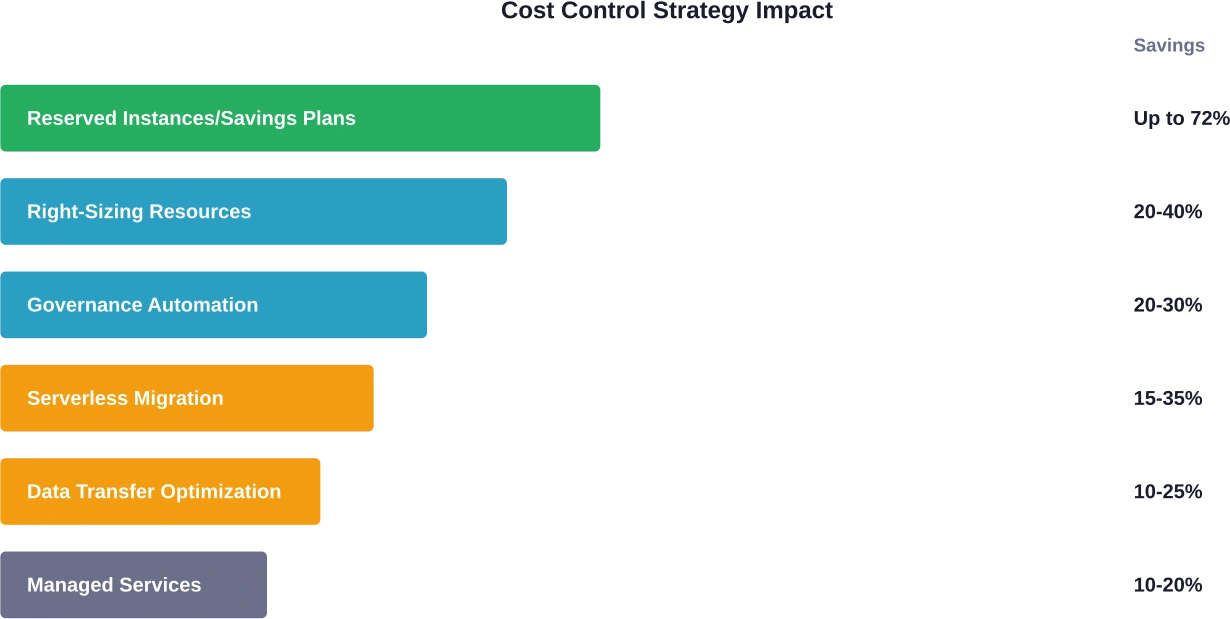
Resource optimization takes months after initial deployment. First deployments tend toward overprovisioning. Teams select larger instance sizes, allocate extra storage, and add redundancy layers to ensure stability. Once workloads stabilize, rightsizing those resources cuts costs by 20-40%, but this optimization work requires dedicated effort.
Monitoring and observability tools become operational expenses. Cloud environments need visibility into performance, costs, and security. These platforms charge based on data ingestion volumes, user seats, or feature tiers. What starts as a few hundred dollars monthly can scale to thousands as monitoring coverage expands.
Backup and disaster recovery in cloud environments work differently than on-premises. Snapshot storage, cross-region replication, and recovery testing all carry ongoing costs. Organizations discover they're paying for backup storage they never validated actually works.
Software maintenance and updates shift to continuous cycles in cloud-native environments. The operational tempo increases compared to traditional release schedules. Teams need automation tools, CI/CD pipelines, and container orchestration—each adding to monthly cloud bills.
The Optimization Cycle
Continuous cost management becomes necessary rather than optional. Cloud resources scale dynamically, usage patterns change, and vendor pricing updates regularly. Organizations that review spending monthly and adjust resources quarterly maintain control. Those treating cloud costs as set-and-forget watch expenses climb steadily.
Strategies to Control Cloud Migration Expenses
Smart planning and deliberate choices reduce migration costs without sacrificing outcomes. These approaches work across different cloud platforms and migration scenarios.
Start with comprehensive assessment. Understanding current workload resource consumption, performance requirements, and interdependencies prevents expensive surprises. Tools like Azure Migrate or Google Cloud's migration assessment services provide data-driven sizing recommendations.
Prioritize workloads strategically. Not everything needs to migrate simultaneously. Moving simple, stateless applications first builds team expertise before tackling complex, stateful systems. This phased approach also spreads costs over longer periods, easing budget pressure.
Right-sizing from day one prevents waste. Cloud vendors offer instance sizing calculators, but real-world testing in pre-production environments reveals actual requirements. Starting with appropriately sized resources costs less than overprovisioning and optimizing later.
Reserved Instances and Savings Plans
Committing to specific capacity levels over time unlocks substantial discounts. Amazon EC2 Reserved Instances can save up to 72% compared to On-Demand pricing. Azure offers similar savings plans for compute workloads.
But these commitments require accurate usage forecasting. Organizations that guess wrong end up paying for reserved capacity they don't use while also paying on-demand rates for additional resources they need. Start with conservative commitments and expand as usage patterns stabilize.
According to Azure cost optimization resources, organizations can use Azure Advisor to find underutilized resources and get recommendations on reconfiguring or consolidating them. This represents one of the fastest paths to savings.
Leverage Native Cloud Services
Cloud-native services like managed databases, serverless compute, and platform storage options often cost less than running equivalent functionality on virtual machines. The fully managed nature eliminates labor costs for patching, updates, and maintenance.
Serverless architectures particularly shine for variable workloads. Paying only for actual execution time rather than idle server capacity cuts costs dramatically for applications with sporadic usage patterns.
Data Transfer Optimization
Minimizing data movement between cloud regions and to the internet reduces egress charges. Architectural choices matter here—placing compute resources in the same region as data storage, using content delivery networks efficiently, and compressing data before transfer all impact costs.
Some organizations partner with larger cloud resellers or managed service providers to access better pricing terms. Volume discounts and enterprise agreements can reduce per-unit costs, especially for organizations without massive cloud footprints.
Cloud Migration Timeline and Cost Implications
Migration duration directly affects costs. Longer timelines mean extended periods of running parallel infrastructure and paying migration labor. But rushing creates mistakes that cost more to fix than careful planning would have cost upfront.
Simple migrations moving dozens of applications might complete in 3-6 months. Complex enterprise migrations involving thousands of workloads, legacy system modernization, and significant refactoring can stretch 18-36 months.
The timeline depends on several factors: application complexity, data volume, testing requirements, and organizational change management. Organizations with strong cloud expertise and executive support move faster than those building skills from scratch.
According to case studies referenced in cloud cost literature, organizations using cloud calculators with careful planning have estimated savings exceeding 30% by selecting appropriate instance types and storage configurations.
|
Migration Complexity |
Typical Timeline |
Key Cost Drivers |
|---|---|---|
|
Simple (lift-and-shift) |
3-6 months |
Infrastructure, basic labor, testing |
|
Moderate (some refactoring) |
6-12 months |
Development work, extended parallel run, training |
|
Complex (re-architecture) |
12-24 months |
Significant development, change management, optimization |
|
Enterprise transformation |
18-36 months |
All factors plus governance, multi-team coordination |
Platform-Specific Cost Considerations
Different cloud platforms structure pricing differently. Understanding these variations helps select the right platform and optimize costs accordingly.
AWS Migration Costs
AWS charges based on service consumption with granular pricing for compute, storage, network, and API requests. Even baseline services accumulate costs: Amazon API Gateway at $3.50 per million requests (baseline rates per AWS Cloud Migration Factory documentation), Lambda invocations, and various resource charges combine into monthly bills.
AWS offers migration incentive programs and credits for new customers, but these expire. Long-term cost control requires commitment to Reserved Instances or Savings Plans.
Azure Migration Economics
Azure structures pricing around subscription tiers and resource groups. Azure Migrate provides free assessment tools, but the actual migration and ongoing operations carry standard consumption charges.
Azure's cost optimization resources emphasize sustained use discounts—using resources for more than 25% of the billing cycle automatically reduces rates. This benefits consistent workloads but doesn't help sporadic usage patterns.
Google Cloud Platform Pricing
Google Cloud offers migration incentives including $300 in free credits available for new customers migrating to BigQuery. The platform structures pricing around sustained use and committed use discounts.
Google's pricing for services like Cloud Key Management runs per active key version plus operation charges. Organizations with hundreds of keys and millions of operations need to model these granular costs carefully.
When Cloud Migration Doesn't Make Financial Sense
Not every workload benefits from cloud migration financially. Some scenarios favor keeping systems on-premises or in colocation facilities.
Highly stable workloads with predictable resource consumption running on fully depreciated hardware cost almost nothing to operate on-premises. Migrating them to cloud subscriptions increases expenses without operational benefits.
Applications with massive data sets that rarely change but frequently get accessed face egregious egress charges in cloud environments. The storage might be cheap, but serving that data to users or other systems costs more monthly than on-premises hosting.
Regulatory requirements sometimes mandate on-premises or specific geographic hosting that makes cloud options prohibitively expensive or infeasible. Compliance costs can overwhelm cloud economics in heavily regulated industries.
Legacy systems nearing end-of-life don't justify migration investment. Spending significant money moving an application that's being replaced in 12 months makes no financial sense.
FAQs About Cloud Migration Costs
What is the average cost of cloud migration?
Cloud migration costs vary dramatically based on workload complexity, data volume, and chosen service models. Small migrations might cost $50,000-$200,000, while enterprise transformations can run $500,000 to several million dollars. The service model (IaaS, PaaS, or SaaS) fundamentally changes cost structures, with IaaS requiring more internal management labor while SaaS shifts costs to ongoing subscriptions.
How long does a typical cloud migration take?
Simple lift-and-shift migrations complete in 3-6 months, while complex enterprise transformations requiring re-architecture can span 18-36 months. Timeline directly affects costs through extended parallel infrastructure operation and migration labor expenses. Organizations with existing cloud expertise and strong executive support move faster than those building capabilities from scratch.
What are the biggest hidden costs in cloud migration?
Indirect costs like staff training, organizational change management, and downtime during cutover often add 20-30% to initial estimates. Data egress fees, API request charges, and the need to run parallel on-premises and cloud environments during migration catch organizations off guard. Post-migration optimization work and governance automation also require investment beyond initial migration budgets.
How can Reserved Instances reduce cloud costs?
Reserved Instances deliver savings up to 72% compared to on-demand pricing by committing to specific capacity levels over 1-3 year terms. These work best for predictable, steady-state workloads. Organizations must forecast usage accurately—committing to capacity not used wastes money, while underestimating needs means paying on-demand rates for additional resources. Start conservatively and expand reservations as usage patterns stabilize.
What factors influence cloud migration cost the most?
Workload complexity and required refactoring drive the highest costs. Applications needing significant re-architecture for cloud environments require substantial development investment. Data volume affects storage and transfer costs, while the migration timeline determines how long parallel infrastructure runs. The chosen service model (IaaS vs PaaS vs SaaS) fundamentally alters the cost structure and ongoing operational expenses.
Are cloud migration costs one-time or ongoing?
Cloud migration involves both one-time migration costs (planning, labor, data transfer, parallel systems) and ongoing operational costs (subscriptions, storage, network, monitoring). Many organizations focus on upfront migration expenses while underestimating ongoing consumption costs. Post-migration optimization, continuous governance, and regular right-sizing become necessary operational activities that require dedicated budget.
How do I calculate cloud migration ROI?
Calculate total migration costs including direct expenses (infrastructure, labor, licensing) and indirect costs (training, downtime, organizational changes). Compare this to projected savings from reduced on-premises infrastructure, lower maintenance, improved scalability, and operational efficiencies. Factor in ongoing cloud operational costs and optimization efforts. Organizations with governance-driven migration models achieve better ROI by preventing cost overruns through continuous visibility and control.
Making Cloud Migration Financially Viable
Cloud migration costs become manageable when organizations approach them systematically rather than reactively. The difference between budget overruns and controlled spending comes down to planning depth and governance implementation.
Start with comprehensive assessment. Understand current resource consumption, application dependencies, and business requirements before committing to migration timelines or budgets. Tools from major cloud providers offer free assessment capabilities—use them.
Model both direct and indirect costs. The 20-30% that organizations typically underestimate comes from ignoring training, change management, governance automation, and post-migration optimization. Budget for these explicitly.
Implement governance from day one. Cost visibility, resource tagging, budget alerts, and automated policies prevent runaway spending. Organizations that treat governance as optional pay for that decision through uncontrolled costs that emerge too late to prevent.
Plan for continuous optimization. Initial deployments rarely achieve optimal cost efficiency. Regular reviews, right-sizing exercises, and architecture refinements reduce spending by 20-40% over the first 12 months post-migration.
The organizations succeeding financially with cloud migration share common traits: they plan thoroughly, budget conservatively, govern continuously, and optimize relentlessly. Those struggling skipped one or more of these steps.
Cloud migration delivers real value—scalability, agility, innovation velocity—but only when costs stay controlled. The tools, frameworks, and strategies exist to achieve that control. Implementation separates successful migrations from expensive disasters.
Ready to plan a cloud migration that stays within budget? Start with a comprehensive assessment of current infrastructure, model both direct and indirect costs using the frameworks outlined here, and implement governance automation before migrating the first workload. Contact cloud migration specialists to validate cost models and ensure realistic budgeting that accounts for the full migration lifecycle.


