

AWS Cloud Migration Cost: 2026 Budget and Pricing Guide

Executive Summary: AWS cloud migration costs vary significantly based on workload complexity, data volume, and chosen migration strategy. While AWS offers free tools like Migration Evaluator and AWS Application Migration Service (with 90 days/2,160 hours of free replication per source server), total costs include infrastructure provisioning, data transfer, security setup, and ongoing operational expenses—typically requiring 30-40% of budget for infrastructure alone.
Moving workloads to AWS sounds straightforward until the bill arrives. The difference between expected and actual migration costs can shock even experienced teams.
Here's the thing though—AWS migration costs aren't as unpredictable as they seem. With proper planning and the right tools, organizations can accurately forecast expenses and avoid common budget traps.
Understanding the AWS Migration Cost Structure
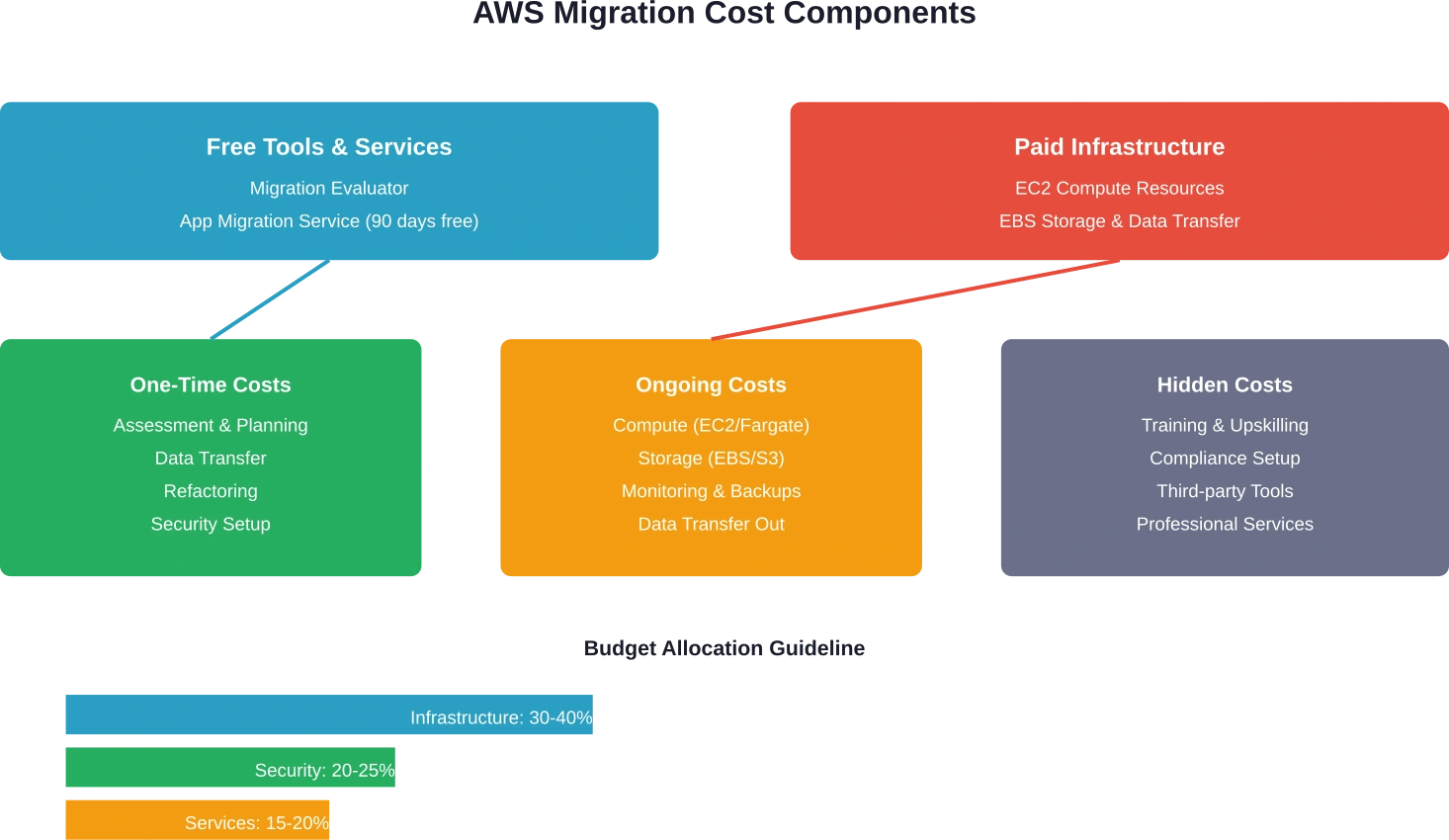
AWS cloud migration costs split into two distinct categories: one-time migration expenses and ongoing operational costs. Each requires separate budget planning.
The one-time costs cover everything needed to actually move workloads to AWS. This includes assessment tools, data transfer, application refactoring, security configuration, and professional services if needed.
Ongoing costs kick in after migration completes. These include compute resources, storage, data transfer, backups, monitoring, and optimization efforts. According to data showing migration outcomes, infrastructure and compute provisioning typically consumes 30% to 40% of total migration investment for European SMBs.
Free AWS Migration Tools That Reduce Initial Costs
AWS provides several complimentary services that significantly lower migration planning expenses.
- Migration Evaluator offers the most value upfront. According to the official AWS pricing page, Migration Evaluator is a complimentary service and creates data-driven assessments and business cases for AWS cloud planning and migration. Teams can inventory existing environments, identify workload details, and design migration plans without spending a dollar.
- AWS Application Migration Service follows a unique pricing model. According to the official AWS website, Application Migration Service pricing documentation states there is no charge for the service during initial replication, but infrastructure provisioning charges apply during and after this period. That represents substantial savings for teams migrating hundreds of servers.
But wait. Those free tools don't eliminate all costs.
While your source servers actively replicate (including during the free period), charges accrue for AWS infrastructure provisioned to facilitate data replication. When launching test or cutover instances, compute (Amazon EC2) and storage (Amazon EBS) resources incur standard AWS charges.
Primary Cost Drivers in AWS Migration
Several factors determine whether migration costs land at the low or high end of estimates. Understanding these helps teams build realistic budgets.
Workload Complexity and Migration Strategy
The chosen migration approach dramatically impacts costs. AWS supports seven migration strategies (The 7 Rs), each with different financial implications.
Rehosting (lift-and-shift) moves applications as-is to EC2 instances. This approach requires minimal refactoring, keeping one-time costs lower but potentially locking organizations into legacy patterns that prevent using cloud-native capabilities they're paying for.
Replatforming and refactoring demand more upfront investment but unlock better cost optimization long-term. Containerizing applications for ECS or EKS increases initial modernization effort but can reduce compute costs significantly.
Based on AWS containerization TCO analysis, for three applications with 40 tasks on m5.large instances with continuous provisioned status in US-East (N.Virginia), estimated annual compute costs would be approximately $11,212.
Data Volume and Transfer Costs
Data transfer represents a frequently underestimated expense. AWS Database Migration Service (DMS) includes some transfers for free—specifically database transfers into AWS DMS and transfers between DMS and Amazon RDS or EC2 instances in the same availability zone.
However, data egress charges apply when moving data out of AWS or across regions. For large datasets (terabytes or petabytes), these costs accumulate quickly.
Storage costs also scale with data volume. Based on containerization cost examples, using 20 GB of storage per task as a starting point, storage costs would be $960 annually (20 GB × $0.1 per GB/month × 40 tasks × 12 months). However, Fargate provides the first 20 GB per task at no extra cost, so actual storage costs remain $0.00 until exceeding that threshold.
Infrastructure Provisioning Requirements
As noted earlier, infrastructure and compute provisioning consumes 30% to 40% of total migration investment for most organizations. This category includes EC2 instances, EBS volumes, load balancers, and networking components.
Right-sizing resources prevents overspending. Teams often over-provision initially out of caution, then fail to optimize afterward. The AWS Pricing Calculator helps estimate monthly costs based on specific service configurations.
|
Migration Strategy |
Upfront Cost Level |
Best For |
Long-term Optimization |
|---|---|---|---|
|
Rehost (Lift-and-Shift) |
Low to Medium |
Fast migrations with tight deadlines |
Limited |
|
Replatform |
Medium |
Moderate cloud optimization needs |
Moderate |
|
Refactor/Re-architect |
High |
Maximum cloud-native benefits |
High |
|
Repurchase |
Medium to High |
Moving to SaaS alternatives |
High |
|
Retire |
Minimal |
Eliminating unused workloads |
Maximum savings |

Estimate Your AWS Cloud Migration Cost
AWS cloud migration cost depends on infrastructure size, data volume, and system dependencies. OSKI Solutions reviews your current environment before defining migration scope. The estimate includes infrastructure setup, data transfer, configuration, and testing. This provides a clear migration budget before execution.
Ready to Plan Your AWS Migration Budget?
Talk with OSKI Solutions to:
- assess current infrastructure and workloads
- define migration stages and risks
- receive a detailed AWS cloud migration cost estimate
👉 Request an AWS migration quote from OSKI Solutions.
Migrate to AWS with Confidence
Move your applications, databases, and infrastructure to the cloud with secure and seamless AWS migration services.
Hidden and Ongoing Costs That Catch Teams Off Guard
The obvious migration costs appear in initial estimates. The hidden ones cause budget overruns.
Security, Compliance, and Governance
According to analysis of European SMB migration patterns, security, compliance, and governance setup becomes the primary focus for regulated industries. This category consumes significant budget but can't be skipped or underfunded.
Implementing proper IAM policies, encryption, logging, monitoring, and compliance controls requires specialized expertise. Organizations frequently underestimate the time and tools needed to meet regulatory requirements like GDPR, HIPAA, or PCI DSS in cloud environments.
Training and Operational Readiness
A common budget mistake: underinvesting in training. This creates operational dependency on external teams that persists for years, driving up long-term costs.
Cloud operations differ fundamentally from on-premises management. Teams need training on AWS-specific services, cost optimization techniques, security best practices, and automation tools. Skipping this investment limits the ability to manage costs effectively post-migration.
Modernization Debt
Skipping application modernization locks organizations into legacy patterns that prevent using cloud-native capabilities they're already paying for. This "modernization debt" accumulates over time, requiring eventual refactoring at higher costs than addressing it during initial migration.
Calculating and Estimating AWS Migration Costs
Accurate cost estimation starts with comprehensive inventory. Migration Evaluator helps with this by inventorying existing environments, identifying current workload information, and supporting migration design and planning—all at no cost.
The AWS Pricing Calculator provides estimates for specific service configurations. Teams input their expected resource requirements (instance types, storage volumes, data transfer amounts) and receive monthly cost projections.
Real talk: initial estimates always miss something. Build in a 20-30% contingency buffer for unexpected costs.
The Five-Step Calculation Framework
Organizations can follow a structured approach to cost estimation:
- Inventory current infrastructure: Document all servers, applications, databases, storage systems, and networking components.
- Map workloads to AWS services: Determine which AWS services best match each workload based on the chosen migration strategy.
- Calculate infrastructure costs: Use the AWS Pricing Calculator to estimate EC2, EBS, S3, RDS, and other service costs.
- Factor in migration-specific expenses: Include data transfer, professional services, training, security tools, and testing infrastructure.
- Project ongoing operational costs: Estimate monthly AWS bills, support plans, monitoring tools, and optimization efforts.
Cost Optimization Strategies for AWS Migration
Migration planning should include optimization from day one, not as an afterthought.
Reserved Instances and Savings Plans offer savings compared to on-demand pricing for predictable workloads. AWS DMS usage qualifies for Database Savings Plans, which offer savings in exchange for committed usage levels.
Right-sizing prevents paying for unused capacity. Start conservative with instance sizes, monitor actual utilization, then adjust based on real performance data.
Data transfer optimization matters too. Keeping resources in the same availability zone eliminates charges for transfers between DMS and RDS or EC2. AWS DMS Fleet Advisor, a free feature, helps with planning database migration processes to avoid unnecessary costs.
|
Cost Optimization Tactic |
Potential Savings |
Implementation Difficulty |
Best Timing |
|---|---|---|---|
|
Reserved Instances |
30-70% |
Low |
After 1-3 months of stable usage |
|
Right-sizing Resources |
15-30% |
Medium |
Continuous process |
|
Spot Instances (non-critical) |
50-90% |
Medium |
For fault-tolerant workloads |
|
Storage Lifecycle Policies |
40-60% |
Low |
During migration planning |
|
Data Transfer Optimization |
10-25% |
Medium |
Architecture design phase |
Real-World Cost Expectations for 2026
What should organizations actually budget for AWS migration in 2026?
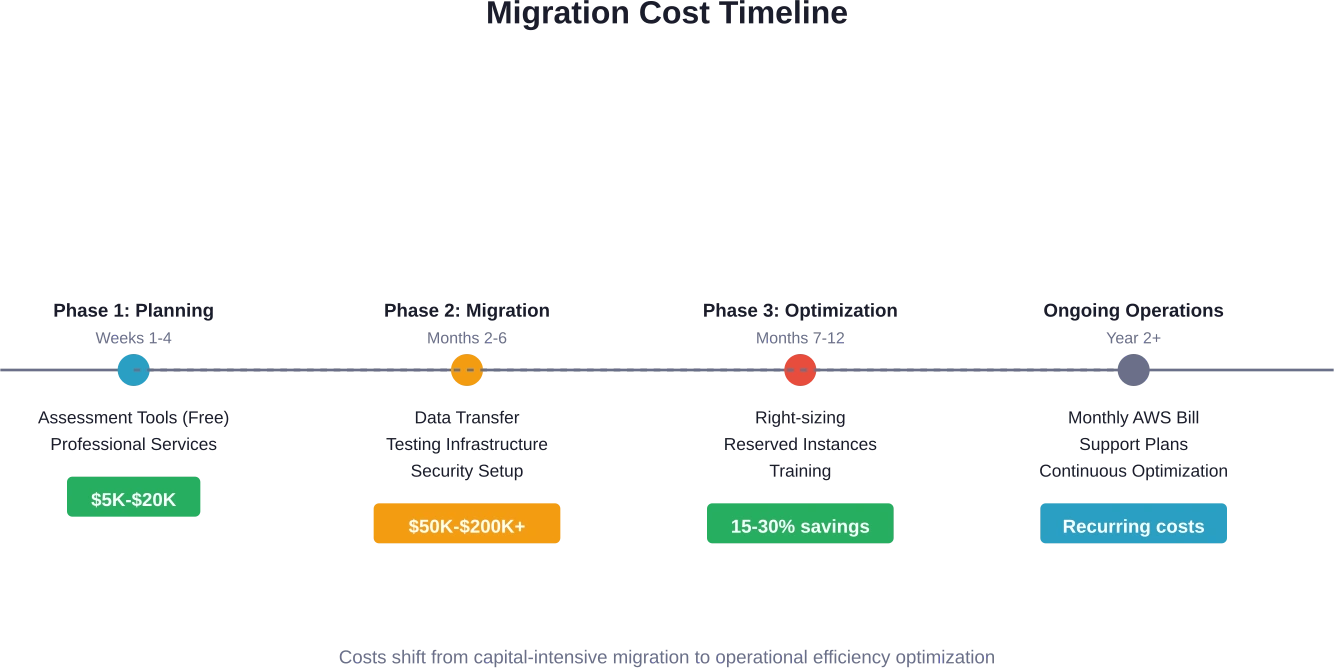
Small to medium businesses typically spend $50,000 to $250,000 for complete migration projects, depending on complexity. This includes assessment, migration services, infrastructure provisioning, security setup, and initial optimization.
Enterprise migrations with hundreds of servers and complex applications can exceed $1 million in total costs. According to available research, well-executed migrations can reduce compute and storage costs by up to 66% compared to on-premises infrastructure.
The financial equation extends beyond direct AWS costs. AWS infrastructure has proven to be up to 4.1 times more energy efficient than typical on-premises setups, contributing to ESG goals while reducing operational expenses.
But here's what matters most: migration costs should be evaluated against total cost of ownership over 3-5 years, not just the initial migration period. Organizations that skip modernization or underinvest in training end up spending more long-term despite lower upfront costs.
Common Budget Mistakes and How to Avoid Them
Several predictable mistakes drive budget overruns.
- Mistake #1: Focusing only on infrastructure costs. Teams budget for EC2 and EBS but forget security tools, monitoring platforms, backup solutions, and support plans. Build comprehensive budgets that include all operational requirements.
- Mistake #2: Underestimating data transfer volumes. Large datasets take longer and cost more to migrate than initially estimated. Test data transfer speeds and costs with pilot migrations before committing to timelines.
- Mistake #3: Treating migration as a one-time project. Cloud operations require ongoing investment in optimization, training, and modernization. Budget for continuous improvement, not just the initial move.
- Mistake #4: Ignoring compliance and governance complexity. Regulated industries face additional costs for security controls, audit logging, and compliance reporting. Factor these in from the start.
Frequently Asked Questions
What AWS migration tools are completely free?
Migration Evaluator is a complimentary service for creating data-driven business cases and migration assessments. AWS Application Migration Service doesn't charge for the service itself during the initial 90 days (2,160 hours) of replication per source server. However, both services incur charges for the AWS infrastructure they provision (EC2, EBS, data transfer).
How long does typical AWS migration take and what does that cost?
Small to medium migrations typically complete in 3-6 months, costing $50,000-$250,000 total. Enterprise migrations can take 12-24 months and exceed $1 million. Timeline and costs depend heavily on workload complexity, data volume, chosen migration strategy, and organizational readiness.
Can AWS migration actually reduce IT costs compared to on-premises?
According to available research, well-executed migrations can reduce compute and storage costs by up to 66% compared to on-premises infrastructure. AWS infrastructure has proven to be up to 4.1 times more energy efficient than typical on-premises setups. However, these savings require proper optimization, right-sizing, and ongoing cost management—not automatic with migration alone.
What's the biggest hidden cost in AWS migration?
Training and operational readiness represent the most commonly underestimated expense. Insufficient investment creates long-term dependency on external teams and prevents effective cost optimization. Organizations should budget 10-15% of total migration costs specifically for training and skills development.
How do I estimate my specific AWS migration costs?
Start with Migration Evaluator (free) to inventory current infrastructure and identify workloads. Then use the AWS Pricing Calculator to estimate specific service costs based on your architecture. Factor in data transfer volumes, security requirements, training needs, and professional services. Build in a 20-30% contingency buffer for unexpected costs.
Do I need professional services or can my team handle AWS migration?
That depends on internal expertise, migration complexity, and timeline requirements. Simple rehost migrations with experienced cloud teams can be self-managed. Complex modernization projects, large-scale enterprise migrations, or teams new to AWS typically benefit from professional services during planning and critical migration phases.
What ongoing costs should I expect after AWS migration?
Ongoing costs include monthly AWS service charges (compute, storage, data transfer), support plans, monitoring and security tools, backup solutions, and optimization efforts. Plan for 15-20% of your initial migration budget annually for continuous optimization and training. Most organizations see monthly AWS bills stabilize 6-12 months post-migration as optimization matures.
Final Thoughts on AWS Migration Costs
AWS cloud migration costs vary dramatically based on workload complexity, chosen strategy, and organizational readiness. The key to accurate budgeting lies in comprehensive planning using free tools like Migration Evaluator and the AWS Pricing Calculator.
Don't make the mistake of viewing migration as purely a cost exercise. Organizations that invest properly in modernization, training, and optimization realize substantial long-term savings and operational benefits that far exceed initial migration expenses.
The most successful migrations balance upfront investment with long-term value. Cutting corners on security, skipping modernization, or underinvesting in training creates technical and financial debt that costs more to address later.
Ready to start planning your AWS migration? Begin with Migration Evaluator to get a data-driven assessment of your current environment and projected AWS costs. The complimentary service provides the foundation for accurate budgeting and successful migration outcomes.


