

AI Development Cost Estimation: 2026 Budget Guide

Brief Overview: AI development costs in 2026 range from $5,000 for basic implementations to over $500,000 for enterprise-scale solutions. Key cost drivers include model complexity, data quality, infrastructure requirements, and integration scope. Organizations can optimize spending through phased rollouts, cloud infrastructure, open-source models, and strategic vendor partnerships.
Planning an AI project without understanding the cost landscape is like navigating without a map. The numbers can swing wildly depending on what you're building, and traditional software budgeting methods just don't apply.
Here's the thing though—AI development costs have become more predictable as the industry matures. Real-world project data shows patterns that help forecast expenses with reasonable accuracy.
This guide breaks down what actually drives AI development costs, backed by data from recent projects and authoritative research. No fluff, just the numbers and factors that matter for budget planning.
Understanding the AI Cost Spectrum
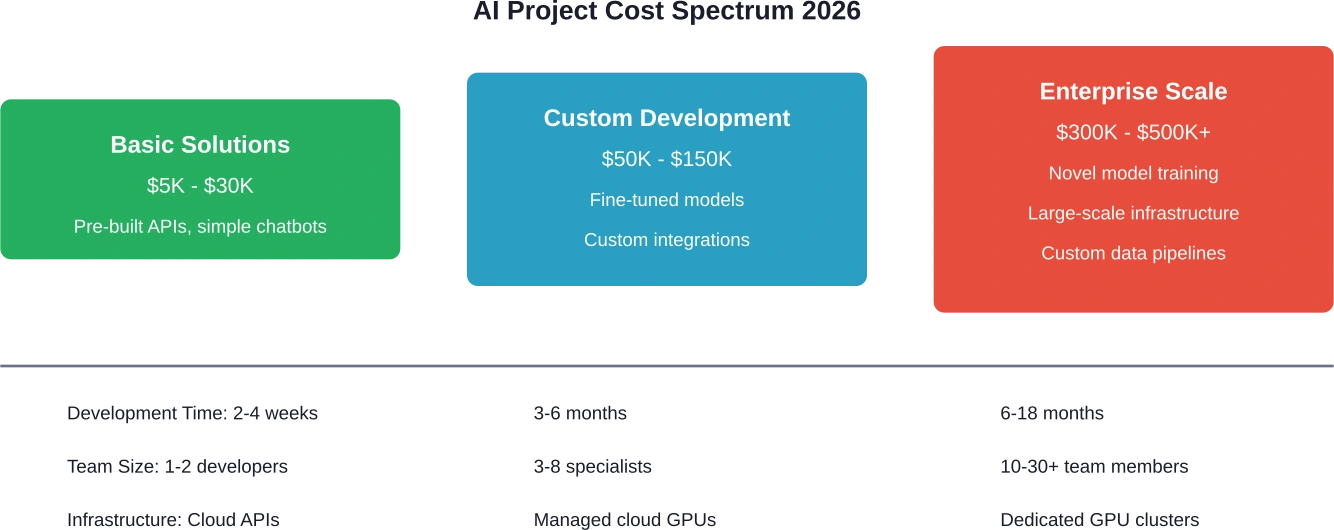
AI project costs span an enormous range. Basic solutions start around $5,000 for simple chatbots or recommendation engines built on existing platforms. Mid-tier custom implementations typically run $50,000 to $150,000. Enterprise-scale systems with novel model development can exceed $500,000.
The gap between these tiers isn't just about features. It reflects fundamental differences in complexity, data requirements, and infrastructure demands.
Research from arXiv on AI training data economics documents data licensing deals that have reached hundreds of millions of dollars, such as Meta's US$14.3B equity stake for data services (valued at 49% of a US$29B company) and Informatica's US$8B acquisition by Salesforce for cloud data integration capabilities.
But wait. These ranges tell only part of the story. The actual cost for any specific project depends on multiple interacting factors.
Primary Cost Drivers in AI Development
Cost estimation for AI projects differs fundamentally from traditional software. Several factors create this unique cost structure.
Model Complexity and Type
The model architecture directly impacts development costs. Simple classification models using standard algorithms might require minimal training infrastructure. Large language models or multimodal systems demand substantially more resources.
Research from arXiv on LLM training data suggests that for state-of-the-art models, data costs should theoretically exceed computational costs. As computational expenses for training grow due to larger model sizes and datasets, the value of high-quality training data increases proportionally.
Custom model training from scratch represents the high end of complexity. Most organizations can avoid this by fine-tuning existing models or using pre-trained options.
Data Quality and Preparation
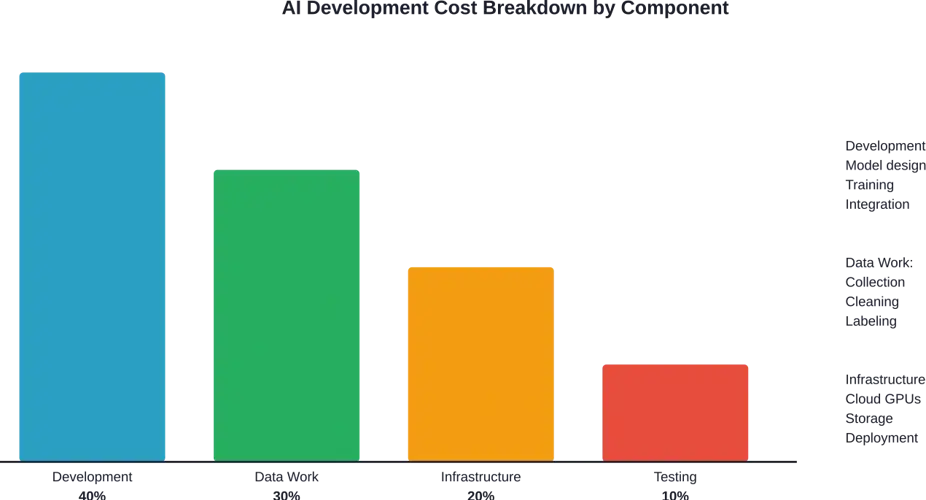
Data work often consumes 60-80% of AI project timelines. Collection, cleaning, labeling, and validation require significant effort before training begins.
High-quality labeled data doesn't come cheap. Domain-specific datasets may need expert annotators. Medical imaging projects require radiologists. Legal document classification needs attorneys. These specialists charge premium rates.
Data licensing adds another layer. Proprietary datasets for training can cost from thousands to millions depending on scale and exclusivity.
Infrastructure and Computing Resources
Training infrastructure represents a major variable cost. According to arXiv research on AI resource costs (From FLOPs to Footprints), training GPT-4 scale is estimated to require approximately 25,000 to 30,000 Nvidia A100 GPUs over several months.
For most projects, cloud GPU instances provide the practical solution. Research on inference economics (Beyond Benchmarks: The Economics of AI Inference) indicates that A800 80G GPUs have a baseline hourly cost per card of approximately $0.79/hour, generally falling within the $0.51–$0.99/hour range under common assumptions.
Inference costs matter too. Once deployed, models consume ongoing computing resources. High-traffic applications can rack up substantial monthly infrastructure bills.
Integration Complexity
Connecting AI capabilities to existing systems drives significant costs. Legacy system integration often requires custom middleware, API development, and extensive testing.
Data pipeline architecture becomes critical. Real-time predictions need different infrastructure than batch processing. The integration approach affects both initial development costs and ongoing maintenance expenses.
Team Expertise and Location
AI specialists command premium salaries. The team composition directly impacts budget requirements:
- Machine learning engineers design and train models
- Data scientists analyze data and validate approaches
- MLOps engineers handle deployment and infrastructure
- Domain experts ensure solutions meet business requirements
- Software engineers integrate AI into applications
Geographic location creates substantial cost variations. Development teams in North America or Western Europe typically charge higher rates than teams in Eastern Europe or Asia.

Understand the Real Cost of AI Development
AI development requires data preparation, model integration, and infrastructure setup. OSKI Solutions evaluates your data and technical requirements before estimating costs. The budget includes development, testing, and deployment tasks. This reduces uncertainty before work begins.
Ready to Calculate Your AI Budget?
Talk with OSKI Solutions to:
- assess available data and technical scope
- define model and integration requirements
- receive a structured AI cost estimate
👉 Request an AI development cost assessment from OSKI Solutions.
Build Intelligent AI Solutions
We design and deploy scalable AI systems that automate workflows, enhance decision-making, and unlock measurable business value.
Pricing Models for AI Development
How payment is structured affects both cost predictability and project risk distribution. Different models suit different project types.
|
Model |
Budget Predictability |
Flexibility |
Best Use Cases |
|---|---|---|---|
|
Fixed Price |
High - costs locked upfront |
Low - scope changes expensive |
Well-defined projects with clear requirements |
|
Time & Materials |
Medium - costs vary with time |
High - easy scope adjustments |
Exploratory projects, evolving requirements |
|
Dedicated Team |
Medium - predictable monthly |
High - full control over priorities |
Long-term development, ongoing optimization |
|
Milestone-Based |
Medium-High - staged payments |
Medium - flexibility between stages |
Phased rollouts, proof-of-concept validation |
Fixed-price contracts work when requirements are crystal clear. This rarely happens with AI projects. Exploratory phases often reveal that initial assumptions were wrong.
Time and materials arrangements provide flexibility but require trust. Costs can escalate if scope isn't carefully managed.
Milestone-based payment splits projects into phases. Each phase has defined deliverables and costs. This balances predictability with adaptability.
Cost Breakdown by Project Type
Different AI applications have distinct cost profiles. Understanding these patterns helps with ballpark estimation.
Chatbots and Conversational AI
Basic chatbots using existing platforms start around $5,000 to $20,000. These handle simple FAQ-style interactions with predefined responses.
Custom conversational AI with natural language understanding runs $50,000 to $120,000. This includes intent recognition, context handling, and integration with business systems.
Sophisticated virtual assistants with multi-turn conversations and API integrations can exceed $150,000 for enterprise deployments.
Computer Vision Solutions
Image classification for quality control or product recognition typically costs $30,000 to $100,000. This assumes adequate training data exists or can be collected efficiently.
Object detection and segmentation projects run higher—$80,000 to $200,000. These require more complex models and denser annotation of training data.
Real-time video analysis with edge deployment can exceed $250,000 due to optimization requirements and hardware considerations.
Predictive Analytics and Forecasting
Demand forecasting or predictive maintenance systems range from $40,000 to $150,000. Costs depend heavily on data integration complexity and the number of variables considered.
Customer churn prediction or recommendation engines fall in similar ranges—$50,000 to $180,000 for custom implementations with proprietary algorithms.
Natural Language Processing
Document classification and sentiment analysis projects typically cost $30,000 to $90,000 for moderate volumes.
Named entity recognition for domain-specific applications runs $50,000 to $150,000, especially when custom entity types require specialized training data.
Advanced NLP like text generation or summarization using fine-tuned large language models can reach $100,000 to $300,000 depending on scale and customization depth.
Hidden Costs That Derail Budgets
Initial estimates often miss several cost categories that emerge during development.
The Exponential Scaling Trap
AI costs can scale non-linearly. A recommendation engine might budget $50,000, then discover it needs ten times more computing power during peak traffic. Unlike traditional software where costs grow gradually, AI systems can hit exponential cost curves.
Model performance improvements show diminishing returns. Getting from 85% to 90% accuracy might double training time and data requirements. That final 5% improvement can cost as much as the entire initial development.
Data Drift and Model Maintenance
Models degrade over time as real-world patterns shift. Maintaining accuracy requires ongoing retraining, monitoring, and updates.
Monthly maintenance typically runs 15-25% of initial development costs annually. High-stakes applications in rapidly changing domains may require even more frequent updates.
Compliance and Governance
Regulated industries face additional costs for model explainability, audit trails, and compliance documentation. Healthcare and finance applications require extensive validation and regulatory alignment.
Bias testing and fairness evaluation add another layer. Ensuring models don't discriminate requires specialized evaluation frameworks and potentially additional data collection.
Change Management and Training
User adoption doesn't happen automatically. Staff training, documentation, and change management support require budget allocation beyond pure technical development.
Organizations often underestimate these soft costs. Technical success means nothing if users resist or misunderstand the new capabilities.
Strategic Cost Optimization Approaches
Smart planning can substantially reduce AI development costs without compromising outcomes.
Start with Pre-Trained Models
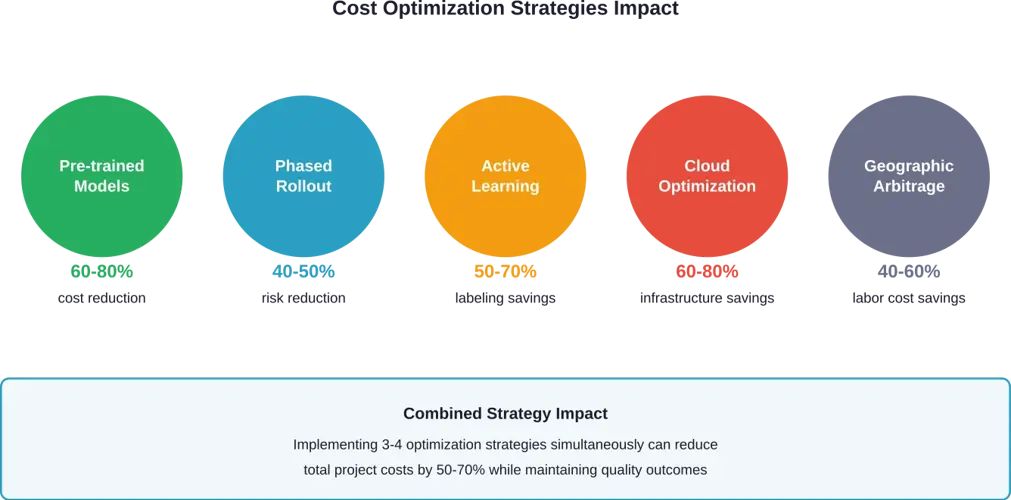
Transfer learning leverages existing models trained on massive datasets. Fine-tuning a pre-trained model costs a fraction of training from scratch.
Open-source models provide powerful starting points. Google's research on multilingual scaling laws (ATLAS) shows that properly scaled pre-trained models can support hundreds of languages efficiently. When expanding to twice as many languages (2·K), model size should increase by 1.18x and total data by 1.66x.
Commercial APIs from OpenAI, Anthropic, or Google offer immediate capabilities without infrastructure investment. The trade-off is ongoing usage costs versus one-time development.
Phased Rollout Strategy
Build a minimum viable AI product first. Prove value with a limited scope before expanding.
Milestone-based development reduces risk. Each phase validates assumptions before committing additional budget. If early results disappoint, pivot or stop without sinking massive resources.
Start with a single use case. Once proven, expand to additional applications using the same infrastructure and learnings.
Optimize Data Strategy
Synthetic data generation can supplement real data. This reduces collection and labeling costs while maintaining privacy.
Active learning identifies which data points provide maximum training value. Instead of labeling everything, focus annotation effort on high-impact examples.
Data augmentation artificially expands training sets through transformations. A single image becomes dozens through rotation, cropping, and color adjustment.
Cloud Infrastructure Optimization
Spot instances and preemptible VMs reduce cloud costs by 60-80% for training workloads that tolerate interruptions.
Right-size infrastructure. Development doesn't need production-scale resources. Scale up only when necessary.
Serverless deployment eliminates idle infrastructure costs. Functions scale automatically with demand and billing reflects actual usage.
Open Source and Community Resources
Leverage existing frameworks rather than building from scratch. TensorFlow, PyTorch, and Hugging Face provide battle-tested implementations.
Google's research on differentially private LLMs (VaultGemma and Scaling Laws for Differentially Private Language Models) demonstrates how open models can provide enterprise-grade capabilities, and research on efficient training with selective data demonstrates substantial cost reductions through smarter data usage.
Community-contributed models and datasets accelerate development. GitHub, Hugging Face, and Kaggle host thousands of ready-to-use resources.
Partner Selection Strategy
Choosing the right development partner affects both cost and outcome quality.
Specialized AI consultancies bring deep expertise but charge premium rates. Generalist development shops cost less but may lack specialized knowledge.
Geographic arbitrage reduces costs. Eastern European and Asian development teams offer 40-60% cost savings compared to North American rates while maintaining quality.
Check for relevant industry experience. A partner who's built similar solutions will move faster and avoid expensive mistakes.
Build vs. Buy Analysis
Not every problem requires custom development. SaaS AI platforms handle many common use cases at predictable monthly costs.
Total cost of ownership includes maintenance, updates, and scaling. Sometimes a $500/month SaaS tool beats a $100,000 custom solution when ongoing costs factor in.
Hybrid approaches work too. Use commercial APIs for commodity capabilities and build custom models only for competitive differentiators.
Estimating Your Specific Project
Creating an accurate estimate requires systematic evaluation of project parameters.
Define Clear Requirements
Vague requirements guarantee cost overruns. Document exactly what the AI system must do, what data exists, and what integration points matter.
Specify performance targets. An 85% accuracy threshold costs dramatically less than 95%. Define what "good enough" means for the business context.
Identify constraints upfront. Latency requirements, privacy regulations, and existing infrastructure limitations all affect approach and cost.
Conduct a Proof of Concept
Small-scale POCs validate feasibility before major investment. A $10,000 proof of concept can prevent a $100,000 mistake.
POCs reveal data quality issues, performance characteristics, and integration challenges. Real-world testing beats theoretical planning.
Set clear POC success criteria. Define what results justify moving to full development versus pivoting or stopping.
Request Detailed Proposals
Get quotes from multiple vendors with identical requirements. Significant variation signals unclear requirements or different interpretation.
Detailed proposals should break costs by phase and component. Lump-sum quotes hide assumptions and make comparison difficult.
Ask vendors to explain their approach. The methodology reveals experience level and potential risks.
Budget for Contingency
AI projects encounter unexpected challenges. Budget 20-30% contingency for unknowns.
Data problems emerge during development. Models underperform. Integration proves harder than expected. Contingency buffer prevents project stalls when issues arise.
Measuring ROI and Justifying Investment
Cost matters, but value matters more. Justifying AI investment requires clear ROI calculation.
Identify Measurable Impacts
Quantify expected benefits before starting. Will the AI reduce operational costs? Increase revenue? Improve customer satisfaction?
Time savings translate to cost savings. If automation saves 100 hours weekly at $50/hour, that's $260,000 annually. A $150,000 AI implementation pays back in seven months.
Revenue impact requires more careful modeling. Recommendation engines might increase conversion rates. Forecast conservatively and track actual results.
Calculate Total Cost of Ownership
Five-year TCO includes initial development, ongoing infrastructure, maintenance, updates, and support.
Annual maintenance typically runs 15-25% of development costs. Infrastructure costs depend on usage patterns but are predictable once deployed.
Compare TCO against projected benefits. Positive ROI typically requires 2-3 year payback for AI investments.
Consider Competitive Necessity
Some AI investments aren't optional. When competitors deploy AI capabilities, matching them becomes a competitive necessity rather than pure ROI calculation.
Customer expectations evolve with technology. Chatbots seemed novel five years ago. Now customers expect instant automated support.
Getting Started with Cost Estimation
Ready to estimate a specific AI project? Follow this process.
Initial Assessment Checklist
Document these elements before seeking quotes:
- Business problem and success criteria
- Available data (type, volume, quality, location)
- Required integrations and existing systems
- Performance and latency requirements
- Compliance and security constraints
- Budget range and timeline expectations
- Team resources and capabilities
This information enables accurate proposals. Missing elements lead to estimates based on assumptions that may prove wrong.
Vendor Evaluation Process
Screen potential partners systematically:
- Review case studies in similar industries or use cases
- Check technical expertise in relevant AI domains
- Evaluate communication and project management approach
- Verify references from past clients
- Compare pricing models and payment terms
- Assess cultural fit and working relationship potential
Technical capability matters most, but communication quality runs a close second. Misunderstandings derail projects regardless of technical skill.
Pilot Project Approach
For large initiatives, start with a paid pilot. Invest $15,000-$30,000 in a focused proof of concept that validates core assumptions.
Successful pilots build confidence for full investment. Failed pilots save money by preventing larger mistakes.
Use pilot results to refine estimates for full development. Real data beats theoretical calculations.
Common Estimation Mistakes to Avoid
Several patterns consistently lead to budget problems.
Underestimating Data Work
Organizations consistently underestimate data preparation time and cost. The assumption that data "just needs cleaning" rarely holds.
Data collection, especially for novel use cases, takes longer than expected. Labeling quality affects model performance more than most realize.
Plan for data work to consume 60-80% of timeline and significant budget. Better to allocate too much than too little.
Ignoring Integration Complexity
The AI model itself often represents the smaller cost component. Connecting it to existing systems, ensuring data flows work, and handling edge cases drives significant expense.
Legacy systems weren't designed for AI integration. Creating reliable data pipelines from old databases requires substantial engineering.
Integration testing takes time. Edge cases emerge in production that never appeared during development.
Comparing Unlike Solutions
Vendor quotes may describe fundamentally different solutions despite similar descriptions. A $50,000 quote and a $150,000 quote might not be comparable.
Dig into methodology, deliverables, and what's included. Understand the difference between a working demo and a production-ready system.
Lowest cost rarely means best value. Experienced teams move faster and avoid expensive mistakes.
Forgetting Ongoing Costs
AI systems require continuous operation, monitoring, and improvement. Initial development represents just the beginning.
Infrastructure costs continue monthly. Model monitoring and retraining requires ongoing data science resources. Bug fixes and feature updates add up.
Budget for at least 20% of development cost annually for maintenance and operation.
|
Cost Component |
Initial Development |
Annual Ongoing |
Notes |
|---|---|---|---|
|
Development Labor |
$40,000 - $300,000 |
$8,000 - $60,000 |
Includes updates and improvements |
|
Data Acquisition |
$5,000 - $100,000 |
$2,000 - $30,000 |
Ongoing data collection and licensing |
|
Infrastructure |
$2,000 - $50,000 |
$10,000 - $100,000 |
Cloud compute scales with usage |
|
Monitoring & MLOps |
$5,000 - $30,000 |
$5,000 - $40,000 |
Model monitoring and retraining |
|
Support & Maintenance |
- |
$5,000 - $50,000 |
Bug fixes, user support |
Industry-Specific Cost Considerations
Different sectors face unique cost drivers that affect estimation.
Healthcare AI
Medical AI requires specialized expertise. Radiologists or clinicians must validate training data and results. This specialized labor increases costs.
HIPAA compliance adds security, audit, and documentation requirements. Healthcare data handling requires additional infrastructure and processes.
Regulatory approval processes may be necessary. FDA clearance for diagnostic AI adds significant time and cost.
Financial Services
Banking and investment AI faces strict regulatory oversight. Model explainability and audit trails aren't optional—they're mandatory.
Financial data security requirements exceed typical standards. Infrastructure costs increase with security layers.
High-accuracy demands in fraud detection or credit decisioning require more sophisticated models and extensive testing.
Retail and E-commerce
Retail AI often handles high transaction volumes. Infrastructure must scale to peak loads like holiday shopping.
Real-time recommendations require low-latency inference. This drives infrastructure design and ongoing costs.
Integration with existing e-commerce platforms can be straightforward or complex depending on platform flexibility.
Manufacturing
Predictive maintenance AI requires sensor data collection infrastructure. IoT deployment may precede AI development.
Edge deployment for quality control or robotics adds complexity. Models must run on local hardware with limited compute resources.
Domain expertise in manufacturing processes becomes critical. Data scientists need to understand the physical processes they're modeling.
Future Cost Trends
Understanding where AI costs are heading helps with long-term planning.
Declining Training Costs
Model training costs continue dropping as hardware improves and algorithms become more efficient. IEEE research on efficient artificial intelligence training with selective data demonstrates how smarter data usage reduces computational requirements.
Open-source models reduce barriers. High-quality pre-trained models become commodities, shifting value to fine-tuning and application.
Rising Data Costs
As public datasets are exhausted, proprietary data becomes more valuable. Research from arXiv on AI training data economics documents data licensing deals from 2020 to 2025, with five distinct pricing mechanisms ranging from per-unit licensing to commissioning, and major deals including Meta's US$14.3B equity stake for data services and Informatica's US$8B acquisition.
High-quality domain-specific data commands premium prices. Organizations that own valuable data gain competitive advantages.
Inference Cost Optimization
Inference represents ongoing operational cost. Research on inference economics shows marginal costs vary significantly based on optimization strategies.
Model compression, quantization, and distillation reduce inference costs while maintaining performance. Increasing Model FLOPs Utilization from 20% to 60% substantially lowers GPU requirements.
Increased Specialization
The field is maturing into specializations. Computer vision experts, NLP specialists, and MLOps engineers command different rates for different skills.
This specialization improves efficiency—the right expert solves problems faster. But it also requires careful team composition planning.
Questions to Ask Development Partners
These questions reveal vendor capability and help compare proposals:
- What similar projects have you completed in our industry?
- How do you handle data quality issues discovered mid-project?
- What's your approach to model validation and testing?
- How do you ensure models remain accurate over time?
- What monitoring and alerting capabilities do you implement?
- How is ongoing maintenance and support structured?
- What happens if the initial approach doesn't achieve target performance?
- How do you manage project scope and prevent scope creep?
- What's included in the quoted price versus additional costs?
- What IP rights and model ownership terms apply?
Listen for specific, detailed answers. Vague responses suggest limited experience.
Frequently Asked Questions
How long does AI development typically take?
Timeline varies dramatically by project complexity. Basic implementations using existing platforms take 4-8 weeks. Custom solutions with model training typically require 3-6 months. Complex enterprise systems can extend to 12-18 months including integration and deployment. Proof-of-concept phases usually run 4-8 weeks and provide timeline clarity for full development.
Can AI development costs be reduced without sacrificing quality?
Yes, through several strategic approaches. Using pre-trained models instead of training from scratch cuts costs by 60-80%. Phased rollouts reduce risk by proving value before full investment. Active learning reduces data labeling costs by 50-70% by focusing on high-value training examples. Cloud optimization through spot instances and right-sizing infrastructure saves 60-80% on computing costs. These strategies maintain quality while substantially reducing expenses.
What's the difference between building AI in-house versus outsourcing?
In-house development requires hiring specialized AI talent at premium salaries—often $120,000-$200,000 annually per team member. Building internal expertise takes time but creates lasting capability. Outsourcing provides immediate access to experienced teams at project-based costs, typically 40-60% less than equivalent in-house salaries in many regions. Outsourcing works well for defined projects; in-house makes sense for ongoing AI as a core competency. Many organizations use hybrid approaches—outsource initial development then transition to internal teams for maintenance.
How do maintenance costs compare to initial development?
Annual maintenance typically runs 15-25% of initial development costs. A $100,000 initial project costs roughly $15,000-$25,000 yearly to maintain. This covers model monitoring, periodic retraining, infrastructure costs, bug fixes, and minor updates. High-stakes applications or rapidly changing domains may require more frequent retraining, increasing maintenance costs to 30-40% of initial development annually. Infrastructure costs scale with usage, so successful applications that grow may see infrastructure costs increase over time.
What causes AI project budgets to exceed estimates?
Data quality problems represent the most common cost overrun driver. Assumed-clean data requires extensive preparation work discovered only during development. Scope creep happens when stakeholders request additional features mid-project. Integration complexity often exceeds expectations, especially with legacy systems. Performance requirements may prove harder to meet than anticipated, requiring more sophisticated models or data. Changes in business requirements during lengthy development cycles force rework. Building 20-30% contingency into budgets prevents these surprises from stalling projects.
Is it possible to estimate AI costs without detailed requirements?
Rough ballpark estimates are possible based on project type and complexity tier, but accuracy suffers significantly. Basic chatbot implementations predictably cost $5,000-$30,000. Custom computer vision solutions typically run $50,000-$150,000. Enterprise-scale systems start around $300,000. However, these wide ranges reflect uncertainty without detailed requirements. Investing in a small requirements-gathering phase or proof of concept—$5,000-$15,000—enables far more accurate estimates and prevents expensive false starts.
How does AI infrastructure cost scale with usage?
Inference costs scale roughly linearly with request volume, though bulk processing achieves economies of scale. Research on inference economics indicates GPU costs around $0.51-$0.99 per hour depending on specifications and optimization. A model serving 1,000 requests daily might cost $200-$500 monthly in infrastructure. Scaling to 100,000 daily requests could push costs to $5,000-$15,000 monthly. Optimization techniques like model quantization, batching, and caching significantly reduce per-request costs. Serverless deployment eliminates baseline costs but charges per invocation—cost-effective for intermittent use, expensive for high-volume applications.
Conclusion: Planning Your AI Investment
AI development costs span an enormous range because projects span an enormous range of complexity. A simple chatbot differs fundamentally from an enterprise-scale computer vision system.
What matters most isn't the specific dollar figure—it's understanding the factors that drive costs for your specific situation. Model complexity, data quality, infrastructure requirements, integration scope, and team expertise all influence the final number.
Smart cost management starts with clear requirements and realistic expectations. Use pre-trained models when possible. Start with proof-of-concept phases that validate assumptions before major investment. Consider phased rollouts that prove value incrementally.
The economics of AI continue evolving. Training costs decline while data costs rise. Infrastructure becomes more efficient but also more sophisticated. These trends favor organizations that focus on unique data assets and business-specific applications rather than reinventing commodity capabilities.
Getting accurate estimates requires detailed project definition and proposals from experienced partners. Invest time in requirements clarity—it pays dividends in estimate accuracy and project success.
Ready to estimate costs for your AI project? Document your requirements using the checklist provided, then engage vendors with specific questions about their approach and experience. Consider starting with a proof of concept that validates feasibility before committing to full development.
The right AI investment delivers measurable business value that far exceeds development costs. Poor planning and unrealistic budgets lead to abandoned projects and wasted resources. The difference lies in understanding what truly drives AI development costs—and now you do.


