

AI App Development Cost Estimation Guide (2026)

Highlights: AI app development costs range from $10,000 for simple projects to $300,000+ for complex enterprise solutions. Key factors include AI model complexity, data infrastructure, team composition, and regional development rates. Budget planning requires understanding both upfront development expenses and ongoing maintenance costs.
The artificial intelligence market is experiencing explosive growth. Valued globally at $40.3 billion, projections show it hitting $221.9 billion by 2034. But here's what everyone wants to know: what does it actually cost to build an AI app?
The answer isn't simple. According to Clutch, the average AI app development cost can range between $10,000 – $49,999. But that's just the starting point.
Real talk: some projects barely crack five figures, while others balloon past $300,000. The difference? Everything from the AI models chosen to where development teams are located matters more than most realize.
Understanding cost estimation for AI projects requires breaking down multiple variables. Data preparation alone can consume 30-50% of the total budget. Infrastructure decisions impact ongoing expenses. Team composition determines hourly rates that vary wildly across regions.
This guide cuts through the confusion. Expect concrete pricing ranges, real cost breakdowns, and strategies that actually reduce expenses without compromising quality.
Understanding AI App Development Cost Fundamentals
AI app development follows different pricing dynamics than traditional software projects. The technology stack, data requirements, and specialized expertise create unique cost structures.
Traditional app development focuses on user interfaces, databases, and business logic. AI apps add layers of complexity: machine learning models, training data pipelines, continuous model retraining, and performance monitoring systems.
Here's the thing though—not all AI apps require the same investment. A chatbot using pre-trained language models costs dramatically less than a custom computer vision system built from scratch.
Basic Cost Tiers
The industry recognizes three general complexity levels:
- Simple AI apps: $5,000 - $50,000
- Medium complexity projects: $50,000 - $120,000
- Complex enterprise solutions: $120,000 - $300,000+
These ranges align with broader app development benchmarks. Simple apps incorporate basic AI features like recommendation engines or sentiment analysis using existing APIs. Medium complexity projects integrate custom machine learning models with moderate training requirements. Complex solutions build proprietary AI systems with extensive data processing and advanced algorithms.
But wait. What determines which category a project falls into?
Core Cost Components
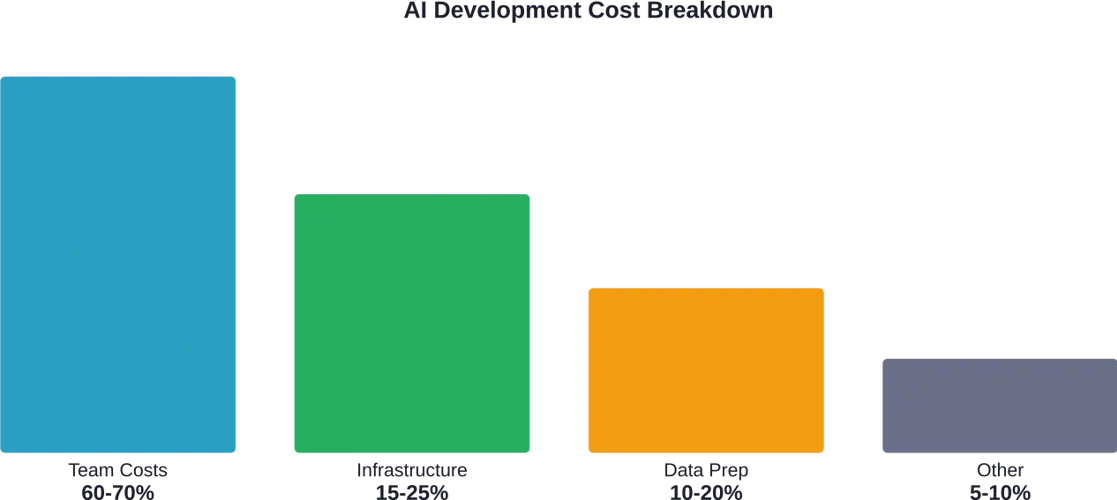
Every AI development budget includes several fundamental elements. Team costs typically represent 60-70% of total expenses. Infrastructure and tools account for 15-25%. Data acquisition and preparation consume 10-20%.
The team composition directly impacts pricing. A minimal viable AI project requires data scientists, AI software developers, and ML engineers. Larger projects add DevOps specialists, data engineers, and domain experts.
Infrastructure choices create ongoing expenses. Cloud computing costs for model training and deployment accumulate monthly. Some teams opt for on-premise solutions that require larger upfront investments but lower recurring fees.

Estimate Your AI App Development Budget
AI apps combine application logic with machine learning components. OSKI Solutions defines system architecture first, then calculates backend and model integration effort. The estimate includes infrastructure and testing stages. This provides a complete development budget.
Ready to Plan Your AI App Budget?
Talk with OSKI Solutions to:
- define app functionality and AI integration
- estimate backend and infrastructure work
- receive a full AI app cost breakdown
👉 Request an AI app development estimate from OSKI Solutions.
Build AI Apps That Stand Out
We develop intelligent mobile and web applications powered by AI to automate workflows, personalize experiences, and drive growth.
Key Factors Influencing AI Development Costs
Multiple variables interact to determine final project pricing. Understanding these factors helps create accurate budget estimates and identify optimization opportunities.
AI Model Complexity and Type
The sophistication of AI models directly correlates with development costs. Pre-trained models from OpenAI, Google, or Hugging Face cost significantly less to implement than building custom neural networks from scratch.
Natural language processing applications using existing transformers can launch for $15,000-$40,000. Custom computer vision systems requiring proprietary training data easily exceed $100,000.
Generative AI applications, conversational agents, and predictive analytics tools each carry different price tags. The model architecture, training requirements, and accuracy expectations all factor into budgets.
Data Infrastructure Requirements
Data represents one of the most underestimated cost drivers. Quality training data doesn't appear magically—it requires collection, cleaning, labeling, and validation.
Data preparation often consumes 30-50% of development timelines. For projects requiring labeled datasets, annotation costs add $0.05 to $5.00 per data point depending on complexity.
Storage infrastructure for large datasets creates ongoing expenses. Cloud storage costs compound with data volume. Processing pipelines need compute resources that scale with dataset size.
Development Team Composition and Location
Team structure significantly impacts project costs. Specialized AI talent commands premium rates, and geographic location creates dramatic pricing variations.
|
Team Size |
Typical Composition |
Best For |
Monthly Cost Range |
|---|---|---|---|
|
Solo Developer |
1 person handling all tasks |
Hyper-casual, simple puzzle games |
$5K-$10K |
|
Small Team (2-5) |
1-2 programmers, 1-2 artists, 1 designer |
Casual mobile games, simple 2D titles |
$20K-$40K |
|
Medium Team (6-15) |
4-6 programmers, 3-5 artists, 2-3 designers, 1-2 QA |
Mid-core games, 3D mobile, indie PC |
$50K-$120K |
|
Large Team (16+) |
10+ programmers, 8+ artists, multiple specialists |
AAA console/PC, complex multiplayer |
$150K-$500K+ |
Regional pricing differences create significant budget flexibility. North American teams charge $120-$250 per hour on average. Western European developers typically cost $100-$150 hourly. Eastern European talent offers $45-$70 rates while maintaining quality standards.
For a minimum viable product, US-based development ranges from $90K-$150K with MVP budget allocation. Eastern Europe costs $30K-$55K for comparable scope.
Integration Complexity
AI systems rarely operate in isolation. Integration with existing enterprise software, databases, and third-party services adds development time and complexity.
Legacy system integration presents particular challenges. Data format conversions, API development, and security protocols require additional engineering resources. Each integration point adds 20-40 hours of development time.
Real-time processing requirements increase infrastructure costs. Applications needing immediate AI predictions require different architectures than batch processing systems.
Regulatory and Compliance Requirements
Industry-specific regulations impact development costs. Healthcare applications must comply with HIPAA. Financial services need SOC 2 certification. European markets require GDPR compliance.
Compliance adds 15-30% to base development costs. Security audits, documentation, and specialized infrastructure all contribute to this premium.
Regional Cost Comparisons and Budget Planning
Geographic location creates some of the most dramatic cost variations in AI development. Choosing where to build matters as much as what gets built.
|
Region |
Hourly Rates |
MVP Budget |
Full Version Budget |
|---|---|---|---|
|
USA |
$145 ($120-$250) |
$90K - $150K |
$150K - $250K |
|
Western Europe |
$110 ($100-$150) |
$70K - $100K |
$120K - $200K |
|
Eastern Europe |
$55 ($45-$70) |
$30K - $55K |
$50K - $90K |
These regional differences don't necessarily reflect quality variations. Many Eastern European and Asian development firms deliver work comparable to North American standards at a fraction of the cost.
Time zone considerations matter for distributed teams. European teams offer better overlap with US business hours compared to Asian developers. Communication efficiency impacts project timelines and, consequently, costs.
Hidden Costs That Catch Teams Off Guard
Budget planning often overlooks several expense categories. These "hidden" costs can add 20-40% to initial estimates.
Model retraining represents an ongoing expense. AI models degrade over time as real-world data drifts from training sets. Quarterly or monthly retraining sessions require data science resources and computing power.
Monitoring and maintenance consume 15-25% of initial development costs annually. Performance tracking, bug fixes, and security patches all require dedicated resources.
API costs for third-party services accumulate based on usage volume. OpenAI's GPT models, Google Cloud Vision, and AWS Rekognition all charge per API call. High-traffic applications can rack up substantial monthly bills.
Cost Breakdown by AI Application Type
Different AI applications carry distinct cost profiles. Understanding typical ranges for specific use cases helps set realistic budget expectations.
Conversational AI and Chatbots
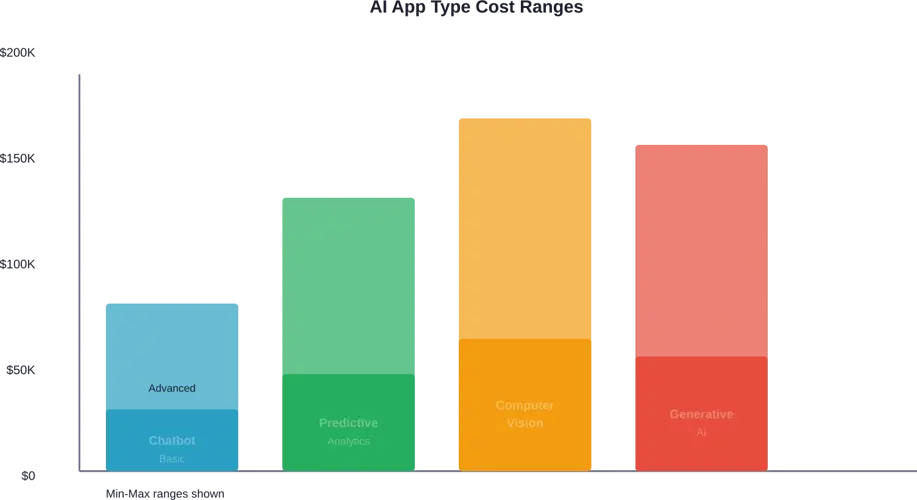
Chatbot projects represent some of the most accessible AI implementations. Basic rule-based chatbots start around $5,000-$15,000. These handle simple queries using decision trees and pattern matching.
Natural language processing chatbots using pre-trained models like GPT or BERT range from $20,000 to $60,000. Custom-trained conversational agents with domain-specific knowledge cost $50,000-$150,000.
The complexity escalates with voice integration, multi-language support, and context retention across conversations. Enterprise chatbots with CRM integration and analytics dashboards reach $100,000+.
Computer Vision Applications
Image recognition and computer vision projects typically cost more than NLP applications. The data requirements and computational demands drive higher expenses.
Basic image classification using transfer learning from models like ResNet or VGG ranges from $30,000 to $80,000. Custom object detection systems for specific use cases cost $80,000-$200,000.
Advanced applications like facial recognition, medical image analysis, or autonomous vehicle vision systems exceed $200,000. These require extensive training data, specialized expertise, and rigorous testing protocols.
Predictive Analytics and Recommendation Systems
Predictive models for business forecasting, customer behavior, or demand planning typically range from $40,000 to $120,000. The cost depends on data complexity, prediction accuracy requirements, and integration needs.
Recommendation engines like those powering e-commerce or content platforms cost $30,000-$100,000 for moderate-scale implementations. Large-scale systems serving millions of users with real-time personalization can exceed $200,000.
Generative AI Applications
Generative AI projects gained massive attention recently. Applications range from content generation to image synthesis and code completion.
Simple content generation tools using API wrappers around GPT-4 or similar models start at $15,000-$40,000. Custom fine-tuned models for specific domains cost $60,000-$150,000.
Image generation systems, text-to-speech applications, and synthetic data generators each carry unique cost structures based on model architecture and training requirements.
Development Team Structure and Pricing Models
How development gets structured and paid for dramatically impacts total costs and project outcomes.
Team Composition Options
AI projects require specialized roles. A minimal team includes a data scientist, ML engineer, and AI software developer. This three-person team costs roughly $15,000-$45,000 monthly depending on location and experience level.
Larger projects add data engineers for pipeline development, DevOps specialists for infrastructure, and quality assurance engineers. Full teams of 6-8 people run $50,000-$150,000 monthly.
The in-house versus outsourced decision carries significant implications. Building internal AI teams requires recruiting costs, benefits, equipment, and ongoing training. Outsourcing trades higher hourly rates for flexibility and reduced administrative overhead.
Common Pricing Models
Fixed-price contracts provide budget certainty but limited flexibility. The entire scope gets defined upfront with a locked-in cost. Changes become expensive. This model works best for well-defined projects with clear requirements.
Time and materials billing charges for actual hours worked. Rates typically range from $45 to $250 hourly depending on role and location. This approach offers maximum flexibility but less budget predictability.
Dedicated team models allocate specific developers to a project full-time. Monthly rates get negotiated based on team composition. This hybrid approach balances flexibility with cost control.
Some agencies offer value-based pricing tied to business outcomes. Cost gets determined by expected return on investment rather than development hours. This model aligns incentives but requires clear success metrics.
Offshore, Nearshore, and Onshore Trade-offs
Geographic distribution strategies each offer distinct advantages. Offshore development in Asia provides maximum cost savings—rates 50-70% lower than North America. But time zone gaps complicate communication.
Nearshore teams in Latin America or Eastern Europe offer moderate savings (30-50% reduction) with better time zone overlap. Cultural and language alignment typically improves compared to offshore options.
Onshore development maximizes communication efficiency and legal simplicity but carries premium pricing. For projects requiring close collaboration or handling sensitive data, the extra cost often proves worthwhile.
Cost Optimization Strategies That Actually Work
Smart budget management doesn't mean cutting corners—it means investing strategically and avoiding unnecessary expenses.
Start with Pre-Trained Models
Building AI models from scratch costs 3-5 times more than leveraging existing solutions. Pre-trained models from OpenAI, Hugging Face, or cloud providers deliver solid performance for many use cases.
Transfer learning allows fine-tuning pre-trained models on specific datasets. This approach captures 80-90% of custom model performance at 30-40% of the cost.
Only invest in custom model development when pre-trained options genuinely can't meet requirements. Proprietary data, unique domains, or specialized performance needs justify the expense.
Focus on Minimum Viable Products
Launching with core functionality reduces initial investment and enables faster learning. MVPs for AI applications typically cost 40-60% of full-featured versions.
The lean approach identifies which features users actually value before investing in comprehensive development. Many planned capabilities turn out unnecessary once real usage data emerges.
Incremental development spreads costs over time and ties additional investment to validated demand. This strategy reduces risk and improves overall ROI.
Optimize Data Preparation
Data costs can be controlled without sacrificing quality. Synthetic data generation creates training sets at lower cost than manual collection and labeling. Tools like NVIDIA's StyleGAN or DataRobot generate realistic artificial datasets.
Active learning techniques identify which data points provide maximum value for model improvement. This focused approach reduces labeling costs by 40-60% while maintaining accuracy.
Data augmentation expands limited datasets through transformations. Image rotation, text paraphrasing, and other techniques multiply training examples without additional collection costs.
Choose Infrastructure Wisely
Cloud versus on-premise decisions significantly impact both upfront and ongoing costs. Cloud platforms offer flexibility and eliminate capital expenditure but accumulate monthly charges.
For development and testing, cloud infrastructure makes sense. Production deployment costs should be analyzed based on usage patterns. High-volume applications sometimes justify on-premise hardware that breaks even within 12-18 months.
Spot instances and reserved capacity provide 40-70% discounts on cloud computing. Planning around these options reduces infrastructure expenses substantially.
Strategic Outsourcing
Not every role requires top-tier talent. Data labeling, basic preprocessing, and routine maintenance can be handled by junior developers or specialized services at lower rates.
Focus premium resources on core AI development—model architecture, training pipelines, and optimization. Commodity tasks can be delegated to lower-cost providers without quality compromise.
Operational Costs and Long-Term Budget Planning
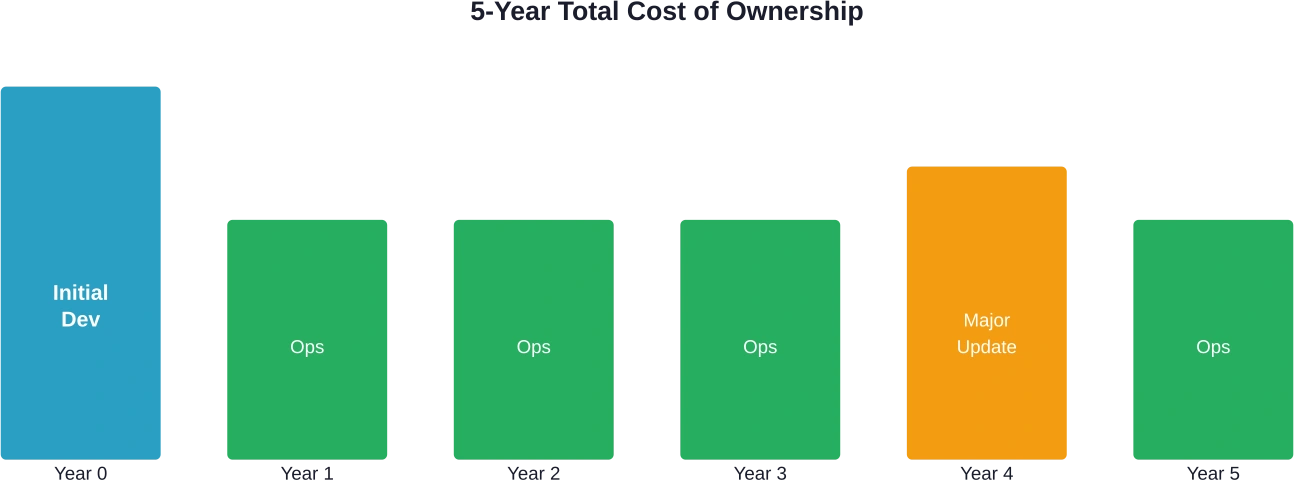
Development represents just the beginning of AI application expenses. Ongoing operational costs often exceed initial build budgets over a 3-5 year lifecycle.
Infrastructure and Hosting
Production AI systems require continuous computing resources. Model inference costs scale with user volume. Simple applications might run $200-$1,000 monthly. High-traffic systems easily exceed $10,000 monthly for infrastructure alone.
GPU resources for model serving add premium charges. Real-time prediction services need dedicated computing capacity that can't be easily scaled down during low-traffic periods.
Model Maintenance and Retraining
AI models degrade as real-world conditions drift from training data. Regular retraining maintains accuracy and relevance. Quarterly retraining cycles typically cost 10-20% of initial development.
Monitoring systems track model performance, data quality, and prediction accuracy. These observability tools cost $500-$5,000 monthly depending on scale and sophistication.
Data Storage and Processing
AI applications accumulate data continuously. User interactions, prediction logs, and training datasets grow over time. Storage costs seem trivial initially but compound with volume.
Data processing pipelines require ongoing computational resources. ETL operations, feature engineering, and data validation all consume cloud computing credits or on-premise capacity.
Support and Updates
Bug fixes, security patches, and feature updates demand dedicated resources. Annual maintenance typically runs 15-25% of initial development cost.
User support for AI applications requires specialized knowledge. Standard customer service teams often can't debug AI-specific issues, necessitating technical support resources.
Cost Estimation Tools and Methodologies
Accurate budget forecasting requires structured approaches and, increasingly, specialized tools designed for AI projects.
Traditional Estimation Approaches
Bottom-up estimation breaks projects into granular tasks with individual time and cost estimates. This detailed approach provides accuracy but requires substantial upfront analysis.
Analogous estimation leverages historical data from similar projects. Teams reference past AI implementations with comparable complexity and scope. This method works well for organizations with established AI development track records.
Parametric models use statistical relationships between project variables and costs. Team size, data volume, model complexity, and integration points feed into formulas that predict total expenses.
AI-Powered Cost Estimation
Emerging tools apply machine learning to project cost prediction. These systems analyze thousands of completed projects to identify cost patterns and relationships between project characteristics and final budgets.
Such tools can process technical requirements, team composition, and regional factors to generate estimates in minutes. Accuracy depends on training data quality and how closely new projects resemble historical examples.
Building Accurate Estimates
Sound estimation requires understanding several key inputs. Functional requirements define what the AI system must accomplish. Technical specifications detail model types, performance targets, and integration needs.
Team velocity data from similar projects provides realistic productivity benchmarks. Knowing that a data scientist completes 15-20 story points weekly enables timeline and cost projections.
Risk assessment identifies uncertainty areas that need budget buffers. Novel AI techniques, unproven data sources, or unclear requirements all warrant contingency allocation of 15-30%.
Industry-Specific Cost Considerations
Different sectors face unique AI development challenges that impact pricing and budget requirements.
Healthcare AI Applications
Medical AI projects carry additional costs from regulatory compliance, specialized expertise, and rigorous validation requirements. HIPAA compliance adds infrastructure and process expenses. Clinical validation studies extend timelines by months.
Medical imaging AI, diagnostic support systems, and patient monitoring applications require domain experts who command premium rates. A medical AI specialist costs 20-40% more than a general data scientist.
Data privacy and security requirements in healthcare justify investments that other industries might skip. Encrypted data storage, audit trails, and access controls all add costs.
Financial Services AI
Banking and insurance AI applications face stringent regulatory oversight. SOC 2 compliance, PCI DSS requirements, and financial audit trails create additional development work.
Fraud detection systems, algorithmic trading platforms, and credit risk models require high accuracy thresholds. The cost of errors in financial AI justifies extensive testing and validation that inflates budgets by 25-50%.
Retail and E-Commerce
Recommendation engines, demand forecasting, and dynamic pricing systems represent common retail AI applications. These projects benefit from abundant training data and established solution patterns.
Retail AI typically costs less than healthcare or financial applications due to lower regulatory burden and greater availability of pre-built solutions. Customization needs drive most expense variation.
Manufacturing and Industrial
Predictive maintenance, quality control, and supply chain optimization represent key manufacturing AI use cases. These applications often require integration with IoT sensors and legacy industrial systems.
Edge computing requirements for factory floor AI add infrastructure costs. Real-time processing on industrial equipment necessitates specialized hardware and deployment strategies.
Common Pitfalls and How to Avoid Them
AI projects frequently exceed budgets due to predictable mistakes. Awareness enables proactive mitigation.
Underestimating Data Requirements
Many projects launch without adequate training data. Collecting, cleaning, and labeling sufficient high-quality data often takes longer and costs more than anticipated.
Conduct thorough data audits before committing to budgets. Identify gaps, assess quality, and include realistic data preparation timelines in estimates. Allocate 30-40% of project budget to data work until proven otherwise.
Scope Creep and Feature Bloat
AI projects tempt teams to continuously add capabilities. "While we're building this, we might as well..." thinking destroys budgets.
Define clear success criteria upfront. Prioritize ruthlessly. Defer nice-to-have features until after MVP validation. Every additional feature adds 15-25% to timeline and cost estimates.
Infrastructure Miscalculation
Development infrastructure needs differ dramatically from production requirements. Testing with small datasets on modest hardware conceals production scaling costs.
Load testing and production simulation reveal actual infrastructure needs. Budget for production-scale infrastructure separately from development environments.
Ignoring Maintenance Costs
Budgets frequently cover development but neglect ongoing operational expenses. This creates sustainability problems post-launch.
Plan for 20-35% of initial development cost annually for maintenance, monitoring, and incremental improvements. Factor these recurring costs into ROI calculations from day one.
Making the Build vs. Buy Decision
Not every AI capability requires custom development. Off-the-shelf solutions and AI-as-a-Service platforms offer viable alternatives for many use cases.
When to Buy Existing Solutions
Standard capabilities like chatbots, document processing, or sentiment analysis rarely justify custom development. Platforms from Microsoft, Google, AWS, and specialized vendors provide production-ready solutions.
Implementation of existing platforms costs 60-80% less than custom development. Setup and configuration for enterprise chatbot platforms typically runs $10,000-$30,000 versus $50,000-$150,000 for custom builds.
Business logic and workflows unique to an organization justify customization. Generic AI capabilities that competitors also use don't create competitive advantage worth large investments.
When Custom Development Makes Sense
Proprietary data that provides competitive advantage justifies custom models. Training AI on unique datasets creates defensible intellectual property.
Highly specialized domains without adequate pre-built solutions require custom development. Niche industries or novel applications need tailored approaches.
Integration requirements sometimes necessitate custom builds. When AI must integrate deeply with proprietary systems and workflows, custom development provides necessary flexibility.
Contract Negotiation and Vendor Selection
Choosing development partners and structuring agreements significantly impacts project costs and outcomes.
Evaluating Development Partners
Technical capability assessment should examine relevant experience, not just general AI expertise. Partners who've built similar applications in comparable domains reduce risk substantially.
Request case studies and client references for projects matching the intended scope and complexity. Verify claimed experience through direct conversations with past clients.
Technical assessments during vendor selection identify capability gaps early. Code reviews, architecture discussions, and proof-of-concept exercises reveal actual expertise versus marketing claims.
Contract Structures That Protect Budgets
Milestone-based payment structures align incentives and manage risk. Payments tied to deliverable completion ensure value receipt before full payment.
Clear scope definition with change order processes prevents budget overruns from creeping requirements. Detailed statements of work specify what's included and what triggers additional charges.
IP ownership clauses deserve careful attention. Ensure contracts specify that developed models, code, and intellectual property transfer to the client upon payment.
Red Flags in Vendor Proposals
Unrealistically low bids often indicate misunderstanding of scope or inexperienced teams. AI development below market rates rarely delivers quality outcomes.
Vague deliverables and unclear success criteria create disputes. Quality proposals specify exact outputs, performance metrics, and acceptance criteria.
Resistance to milestone payments or insistence on large upfront deposits suggests cash flow problems or lack of confidence in delivery capability.
Future-Proofing AI Investments
AI technology evolves rapidly. Smart architecture decisions and development approaches preserve long-term value despite changing technology landscapes.
Building Modular Systems
Loosely coupled architecture allows component replacement without full rebuilds. Separating data pipelines, model serving, and application logic enables independent evolution.
API-based integration between components creates upgrade paths. When better models emerge, swapping them in requires minimal disruption if interfaces remain stable.
Technology Selection Criteria
Open-source frameworks like TensorFlow, PyTorch, and Scikit-learn provide flexibility and avoid vendor lock-in. Proprietary platforms may offer convenience but create switching costs.
Community size and ecosystem maturity indicate technology longevity. Popular frameworks receive ongoing updates, security patches, and community support.
Documentation and Knowledge Transfer
Comprehensive documentation preserves understanding beyond original development teams. Architecture decisions, model choices, and data pipeline logic all need written records.
Knowledge transfer sessions and training for internal teams reduce dependence on external developers. In-house expertise enables ongoing maintenance without continued vendor reliance.
Frequently Asked Questions
How much does it cost to develop a basic AI app?
Basic AI applications typically cost between $10,000 and $50,000. This range covers simple implementations using pre-trained models or existing AI services. A chatbot using GPT APIs or a recommendation system leveraging existing algorithms falls into this category. Development time spans 2-4 months with small teams. Complexity increases costs—custom data preparation, unique business logic, and specialized integrations push projects toward the higher end of this range.
What factors most significantly impact AI development costs?
Team composition and location create the largest cost variations. US-based developers charge $120-$250 hourly while Eastern European teams cost $45-$70 per hour for equivalent expertise. Model complexity represents the second major driver—pre-trained models cost 60-80% less than custom neural networks built from scratch. Data preparation often surprises teams, consuming 30-50% of budgets for projects requiring extensive collection, cleaning, and labeling. Infrastructure choices, integration requirements, and compliance needs round out the key factors.
How long does AI app development typically take?
Development timelines vary based on complexity and scope. Minimum viable AI products require 2-4 months with focused teams. Medium complexity applications take 4-8 months from requirements through deployment. Complex enterprise AI systems often need 8-18 months including data preparation, model development, testing, and integration. These timelines assume dedicated resources and clear requirements. Ambiguous scope, data quality issues, or resource constraints extend schedules significantly.
Should we build AI capabilities in-house or outsource development?
The decision depends on several factors. Outsourcing makes sense for companies without existing AI expertise, one-time projects, or tight timelines. Development costs decrease 30-60% through offshore or nearshore outsourcing. Building internal teams suits organizations planning multiple AI initiatives, handling sensitive data, or requiring ongoing model maintenance. In-house development carries higher upfront costs but lower long-term expenses for sustained AI work. Hybrid approaches work well—outsource initial development while building internal capabilities for maintenance and iteration.
What are typical ongoing costs after AI app deployment?
Annual operational costs typically run 20-35% of initial development expenses. Infrastructure and hosting for production systems cost $200 to $10,000+ monthly depending on traffic volume and processing requirements. Model retraining to maintain accuracy costs 10-20% of development budget quarterly or annually. Maintenance, bug fixes, and security updates consume 15-25% of original development cost yearly. Monitoring tools, API fees, and data storage add smaller recurring expenses that compound over time.
How can startups reduce AI development costs?
Start with pre-trained models rather than building from scratch—this approach cuts costs 60-80% while delivering solid performance for most use cases. Launch with minimum viable products containing only core features, then iterate based on user feedback. Leverage offshore or nearshore development teams for 40-70% cost reduction compared to US-based developers. Use synthetic data generation and data augmentation to reduce expensive manual data labeling. Cloud spot instances and reserved capacity offer 40-70% infrastructure discounts. Focus premium AI talent on core model development while delegating routine tasks to junior developers or specialized services.
What hidden costs should AI project budgets include?
Data acquisition costs often get underestimated—purchasing datasets or licensing data sources can cost $5,000 to $100,000+ depending on volume and specialization. API fees for third-party services accumulate based on usage, potentially reaching thousands monthly for high-traffic applications. Model retraining represents an ongoing expense as AI systems degrade without regular updates. Compliance and security audits add 15-30% to base costs for regulated industries. Performance monitoring and observability tools cost $500-$5,000 monthly. Technical debt remediation typically requires 10-20% of development budget within the first year.
Conclusion
AI app development costs vary dramatically based on project scope, team location, model complexity, and data requirements. Simple implementations start around $10,000 while complex enterprise solutions exceed $300,000.
The key to successful budget planning lies in understanding which factors drive costs in specific situations. Pre-trained models deliver 60-80% cost savings over custom development for many use cases. Regional team selection creates 40-70% pricing variations without sacrificing quality.
Smart cost optimization focuses investment on genuine differentiators while leveraging existing solutions for commodity capabilities. Starting with minimum viable products reduces upfront risk and enables validated learning before major investment.
But here's what matters most: accurate budgeting requires accounting for total cost of ownership, not just initial development. Operational expenses, maintenance, and model retraining add 20-35% of development costs annually.
Now's the time to move from planning to action. Start by defining clear requirements and success criteria. Evaluate whether existing AI platforms meet needs before committing to custom development. Obtain detailed proposals from multiple vendors to establish realistic market rates.
The AI application market continues expanding rapidly—early movers in many industries still hold significant advantages. Thoughtful budget planning and strategic vendor selection turn AI vision into production reality without financial surprises.
Ready to estimate costs for a specific AI project? Begin by documenting functional requirements, expected data volumes, and integration needs. These details enable accurate proposals and productive conversations with development partners.


